The face that became worth its weight in gold
Klimt's gold, Nazi plunder, and an auction house record
3 chaptersAbout 5 min read
Gustav Klimt painted a woman's face in gold. Those portraits, covered in real gold leaf, have captivated people for over a century, but behind that golden surface lies a story that cannot be explained by paint alone. Someone stole that face, someone erased the woman's name from the painting, and after many long years, those faces returned to the world as the most expensive paintings on earth, back on the auction block. This is the story of the faces that became worth their weight in gold.
Eight kinds of gold
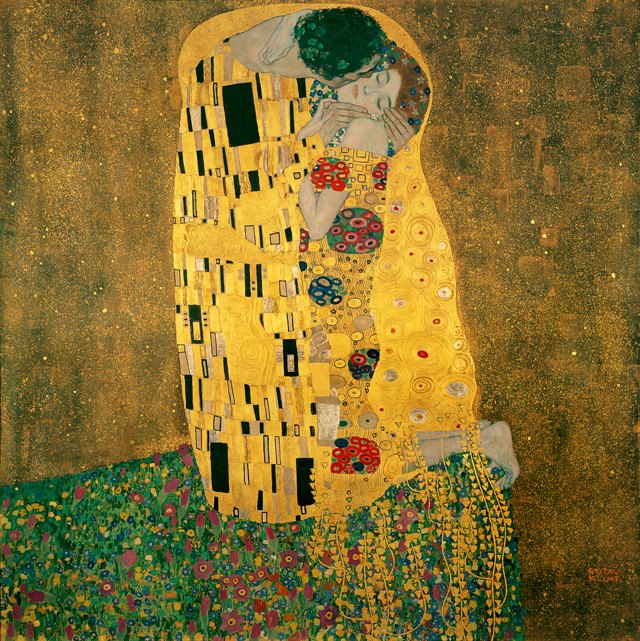
Klimt was the son of a goldsmith. He was captivated for life by the precious metals he saw at his father's fingertips, and that fascination found its direction after he saw the 6th-century Byzantine mosaics in Ravenna, Italy, in 1903. The gold that glittered on the walls of the Basilica of San Vitale found its way onto his canvas a few years later.
That is how The Kiss was born. Commissioned by no one, at the very peak of his Golden Phase. He used eight kinds of gold in this single work alone. He covered the entire canvas in gold leaf, painted over it with dark pigment, and scattered gold fragments once more. Real gold leaf, silver leaf, and platinum leaf formed layers on the surface.
What truly makes this painting special is its contrast: realistically rendered flesh against two-dimensional, abstract golden ornamentation. The two bodies of the lovers are distinguished only by the pattern of their clothing, while everything else floats within a golden universe beyond time and space. Art historians read in this the timelessness of the Byzantine icon — a "modern icon" of Klimt's own making.
His paintings were once called pornographic, even degenerate. Yet The Kiss was purchased by the Austrian government the moment it was exhibited in Vienna, and, carrying the radiance of an altarpiece, became a sacred image for a post-religious age.
Carrying the radiance of an altarpiece, The Kiss became an icon for a post-religious age.
The portrait whose name was stolen
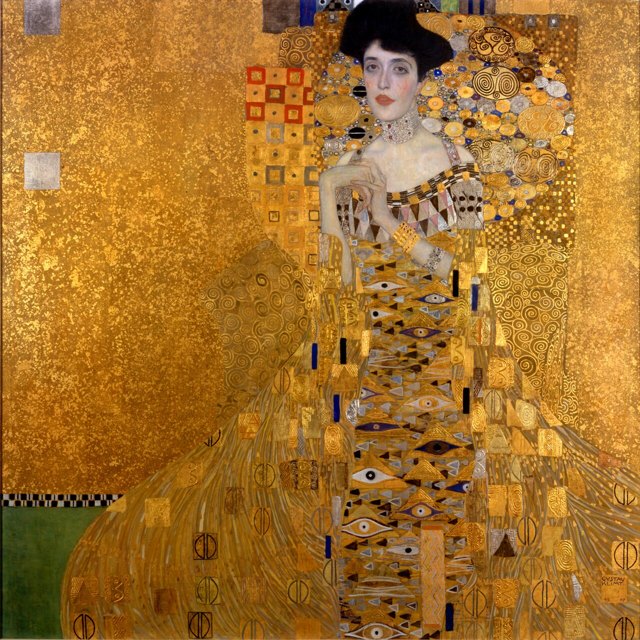
Adele Bloch-Bauer was the only person Klimt painted twice in full-length portrait. In the first portrait of 1907 — the painting that would later be called "Woman in Gold" — he wrapped the woman's body in the radiance of Empress Theodora that he had seen in Ravenna. A golden halo surrounds her face, and the mantle draped over her bears the initials "AB" worked in low relief. It is regarded as the crowning masterpiece of his "Golden Style."
Behind that splendor lies a dark history. The diamond choker Adele wore around her neck was a wedding gift from her husband Ferdinand, but when the Nazis seized the Bloch-Bauer collection in 1938, that necklace passed into the hands of Nazi leader Hermann Göring. The portrait itself was one of five Klimt works the Nazis seized from the family.
The Nazis even erased the painting's name. To conceal the fact that Adele was Jewish, the painting was long referred to in Vienna simply as "Woman in Gold Background." The face remained, but the name had vanished.
It took more than half a century for that name to return. The surviving heir, Maria Altmann, fought a restitution lawsuit for decades; in 2004 the U.S. Supreme Court ruled that she could sue Austria, and in 2006, following an Austrian arbitration ruling, the painting was finally returned to the heirs. That same year, Ronald Lauder purchased it and hung it in the Neue Galerie in New York, where people still come to see that "very special woman."
To conceal her Jewish identity, the Nazis called the painting "Woman in Gold Background."
The face that survived the flames
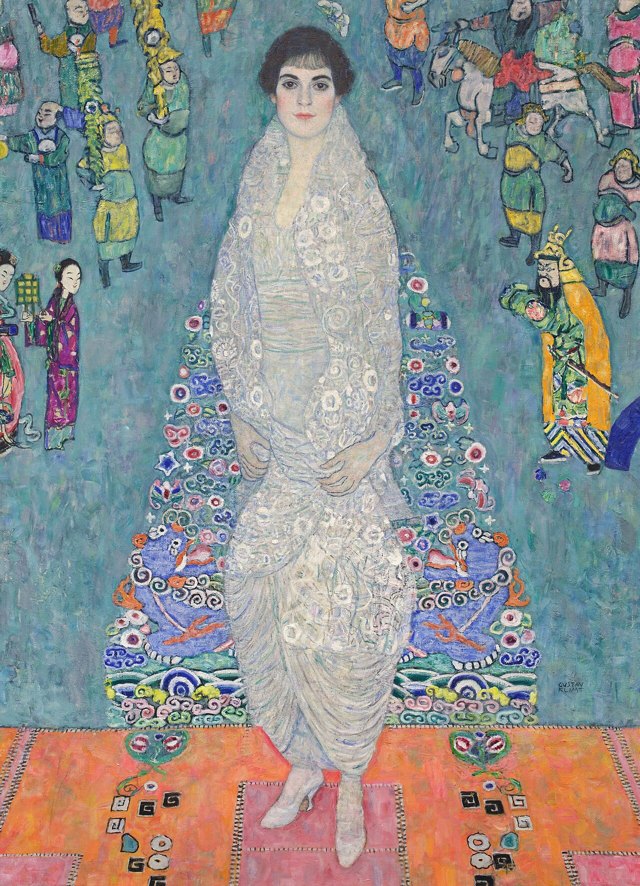
In November 2025, another Klimt portrait sold at Sotheby's in New York for $236.4 million. It became the most expensive face in the history of modern and contemporary art: the "Portrait of Elisabeth Lederer."
Elisabeth was the daughter of the Lederer couple, Klimt's most important patrons. In 1914, at the peak of his artistic fame, the couple commissioned a portrait of their daughter, and the painter placed her, only about twenty years old, front and center. Unlike the distant, dreamy women Klimt often painted, Elisabeth casts a calm, self-assured gaze straight ahead. She is wrapped in a robe patterned with dragons — a reflection, in the fabric's design, of the fascination with Chinese art that had gripped Klimt at the time.
That this face has survived to the present day is close to a matter of chance. During World War II, this portrait too was confiscated by the Nazis. Other Klimt paintings belonging to the Lederer family, seized and moved together with it, were all destroyed when retreating troops set fire to them just before the war's end. Only this canvas narrowly escaped that fate.
In 1948, the painting was returned to the heirs in Geneva, and for nearly 40 years afterward it hung in Leonard Lauder's collection. As it happened, this was less than a mile from the portrait of Elisabeth's mother, Serena Lederer, which Klimt had painted a few years earlier. The faces of mother and daughter hung that close together within a single city.
The paintings seized alongside it burned in the fire, but this one face survived.
One Art History Story a Week — on Instagram
See exhibition news and masterwork stories first, in reels and cards.
Instagram · Updated weekly
Curators behind this story
The facts and interpretations in this story are grounded in the public materials of the experts and institutions below. See each original for the full commentary.
- Belvedere (Austrian Gallery Belvedere collection commentary) · Österreichische Galerie Belvedere, Wien (CC BY-NC-ND 4.0)
- Beth Harris · Steven Zucker · Smarthistory (CC BY-NC-SA)
- James Payne · Great Art Explained (YouTube) (Embed + attribution)
- Neue Galerie (curator commentary from the holding institution) — curated by Janis Staggs · Neue Galerie New York (Embed + attribution)
- Sotheby's (auction catalogue note · scholarly provenance essay) · Sotheby's New York — Leonard A. Lauder, Collector | Evening Auction, Lot 8 (Attribution (auction catalogue note))
Business Inquiry
Leave your partnership proposal and we'll review and reply.