A masterpiece born on the edge of the mind
Van Gogh and Munch — the world seen from the brink of the mind
2 chaptersAbout 4 min read
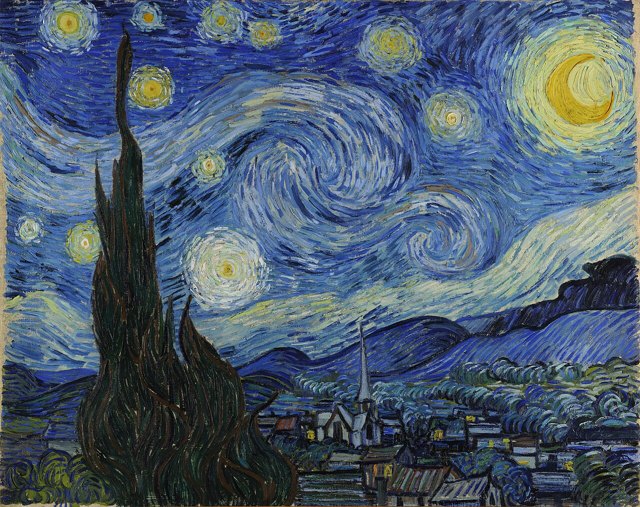
Some paintings are born in the place where the mind is about to collapse. People often call this evidence of madness. But look closer, and the story points in a slightly different direction. Van Gogh and Munch stood at the very edge of the mind's cliff, but rather than leaping off, they stood there and looked at something for a long time. And then they painted what they saw.
The star outside the asylum window
In June 1889, Van Gogh was staying at the Saint-Paul-de-Mausole asylum in Saint-Rémy, in the south of France. He had admitted himself there to ease the suffering of his mental illness, and he spent twelve months in the place. It was a small hospital with only forty-one patients. The medical staff recognized early on how important painting was to his stability, and gave him a space to work and a degree of freedom.
One day he wrote to his brother Theo: "This morning, well before sunrise, I saw the countryside through the window. There was nothing but the morning star, looking very big." That view outside his upstairs room's window became the seed of this painting.
What's interesting is that this painting of the night was not actually painted at night. Unable to paint in the dark, he completed the night sky from memory during the day in the studio downstairs. The sleeping village at the foot of the hill was not actually visible from the window, and the cypress on the left was drawn much closer than it really was. What he saw with his eyes, what he remembered, and what he imagined all mingled together on a single canvas. The cypress, rising like a flame to the top of the sky, stands like a bridge linking earth and heaven. Some read it as a bridge between life and death.
But there is one fact we often forget. This painting is frequently discussed as evidence of madness, but the truth is closer to the opposite. During his time in the hospital, Van Gogh was clear-headed and rational most of the time. He spoke four languages, delved obsessively into color theory, and spent three-quarters of his stay working on paintings. In that time he left behind more than 150 works. He did not paint because of his illness — he painted despite it. Painting gave structure, purpose, and meaning to a man on the verge of collapse.
He did not paint because of his illness — he painted despite it.
What he heard beneath the blood-red sky
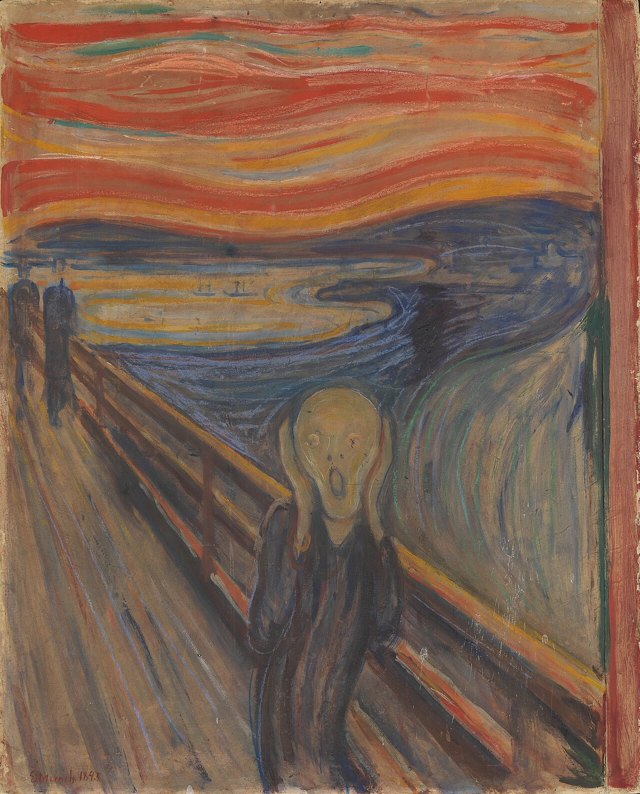
Munch recorded a day in January 1892 in his diary. "I was walking along the road with two friends. The sun was setting. Suddenly the sky turned blood red. I stopped walking. And I felt an immense, endless scream passing through nature." It was on Ekeberg hill in Oslo.
The Scream was born from that moment. The swirling blue landscape and the burning orange sky are less a sunset seen with the eyes than something he felt in his body. The figure at the center of the painting is less a face than a single shape. A skull-like face, neither male nor female. Wide-open eyes and nostrils, and a mouth opened into an oval. This shape has come to be imprinted on people's minds, from Toledo to Timbuktu, almost as the face of anxiety itself.
In the upper left corner of the painting is a faint pencil inscription. "Only a madman could have painted this!" Who wrote it has long been debated, but it is said that Munch himself may have written it. If so, was it a confession, or a quiet rebuttal? Either way, that single line holds us for a long time as we stand before the painting.
I felt an immense, endless scream passing through nature.
One Art History Story a Week — on Instagram
See exhibition news and masterwork stories first, in reels and cards.
Instagram · Updated weekly
Curators behind this story
The facts and interpretations in this story are grounded in the public materials of the experts and institutions below. See each original for the full commentary.
- Dr. Noelle Paulson · Smarthistory (CC BY-NC-SA)
- James Payne · Great Art Explained (YouTube) (Embed + attribution)
- Smarthistory (art historian commentary) · Smarthistory (CC BY-NC-SA)
- Nasjonalmuseet (National Museum of Norway collection commentary) · National Museum of Norway (Nasjonalmuseet) (Embed + attribution)
Business Inquiry
Leave your partnership proposal and we'll review and reply.