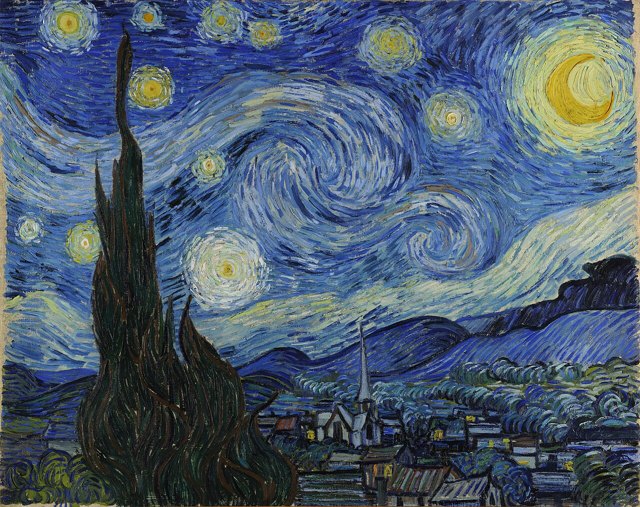
The Starry Night
Collection Museum of Modern Art (MoMA), New York · New York
Why do the stars in this painting shine so brightly?
Key Points
- The painter's dream: turning the view outside an asylum window into imagination
- The aesthetics and symbolism hidden in the stars, moon, and cypress tree
- The painting Van Gogh himself called a "failure"
- The tension between astronomical accuracy and artistic freedom
Reading the Work
Vincent van Gogh painted the view outside the window of an asylum. He painted the wheat fields, mountains, and village he actually saw, but the village was imagined based on a sketch. The cypress tree in the painting was made taller than it really was, and the stars and moon were also painted differently from reality.
Van Gogh painted the sky with ultramarine and cobalt blue, and used Indian yellow and zinc yellow for the stars and moon. The stars were arranged in positions similar to the real night sky, but the moon was not astronomically accurate. He thought of the stars as points on a map, imagining the world after death through the night sky.
This painting is an artistic achievement that brings together Van Gogh's emotion and imagination. His distinctive brushwork and use of color had a great influence on later artists. It is one of the most famous paintings in modern art history, showing artistic freedom that transcends the limits of painting.
One Art History Story a Week — on Instagram
See exhibition news and masterwork stories first, in reels and cards.
Instagram · Updated weekly
Further reading · Smarthistory · CC BY-NC-SA 4.0
Image: Public domain · Wikimedia Commons
Last updated 2026-07-17
Business Inquiry
Leave your partnership proposal and we'll review and reply.