A masterpiece found in an attic
How to find a lost painting — the people who recovered Caravaggio
3 chaptersAbout 7 min read
What does it mean to find a lost painting? In art history, a vanished masterpiece is usually not gone entirely — it is quietly hanging somewhere under someone else's name. So it was with Caravaggio's paintings. One spent long years gathering dust on the wall of a Dublin dining room; one nearly went to auction for a pittance; one was mistaken for another painter's work until a single document brought it back to life. These are the stories of paintings that were lost, and then found again.
The wall of a Dublin dining room
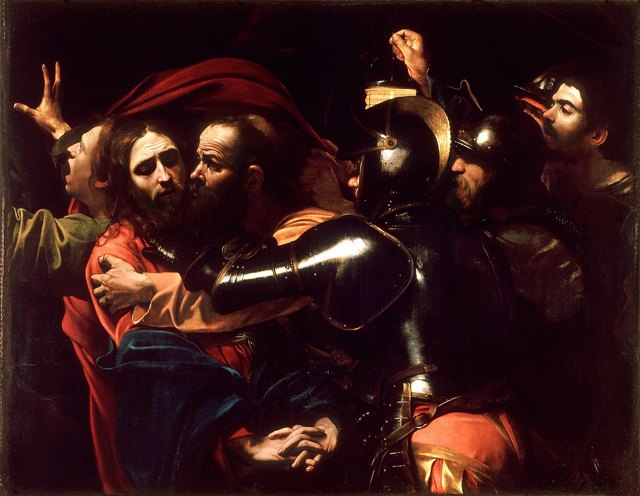
One morning in August 1990, Sergio Benedetti, chief conservator at the National Gallery of Ireland, visited a Jesuit residence on Leeson Street in Dublin. The priests had asked for the restoration of a dark painting hanging in their dining room. Its form was obscured beneath years of accumulated varnish, but he recognized the subject and composition at once. It was the lost Caravaggio, "The Taking of Christ," long known only through copies.
The painting was originally a well-documented work, commissioned directly from Caravaggio in 1602 by the Roman nobleman Ciriaco Mattei. But by the time the Mattei family sold the painting in 1802, Caravaggio's name had become detached from it, and it was mistakenly attributed instead to the Dutch painter Gerrit van Honthorst, one of his followers. There was one small but decisive error involved: Honthorst's nickname, "Gherardo delle Notti" (Gerard of the Night Scenes), was misrecorded in the Mattei documents as "della Notte," and that error was repeated in every subsequent record, erasing the trace of the original. Later, during authentication, that very mistake became a crucial clue.
The painting captures the moment Judas identifies Christ with a kiss. Temple guards close in, while on the left a disciple flees, his robe torn away. Only moonlight illuminates the scene, and in the face of the man holding a lantern at the far right, Caravaggio painted himself, at thirty-one, as an observer. Infrared examination shows he painted directly onto the dark ground, with no underdrawing, and very quickly.
Discovery alone was not proof. Authentication and conservation required consultation with international experts and three years of meticulous research, and the painting was not shown to the world until November 1993, in an exhibition titled "Caravaggio: The Master Revealed." Benedetti later wrote in the catalogue: "Leaving the Jesuit residence that morning, I was excited by what I had just seen, but I could not have imagined that my conviction would be realized in an exhibition exactly three years later."
That morning I was excited, but I could not have imagined my conviction would be realized three years later.
A €1,500 Caravaggio
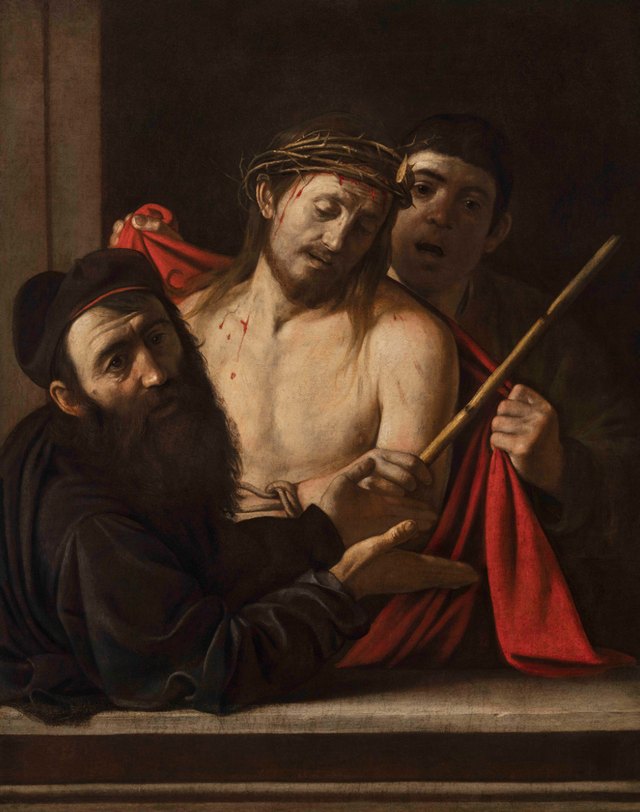
In the spring of 2021, a dark religious painting appeared at an auction house in Madrid. The catalogue listed it as the work of a student of the 17th-century Spanish painter Ribera, with an estimate said to be only around €1,500. It very nearly sold for that price and quietly slipped across a border, gone for good.
Before the auction took place, the Prado Museum recognized the painting's true identity. The museum immediately alerted Spain's Ministry of Culture; the auction was halted, and an export ban was placed on the painting. In a world where only about sixty authenticated Caravaggios survive, one had very nearly vanished for a pittance.
A period of careful verification followed. First came an in-depth diagnostic study by Claudio Falcucci, an expert in applying scientific techniques to cultural heritage, followed by a precise restoration built on that foundation. The opinions of numerous scholars, including Metropolitan Museum curator Keith Christiansen, converged with unprecedented speed. The painting captured the moment Pontius Pilate presents the beaten Christ before the crowd, saying, "Behold the man."
The Prado named this painting the "lost Caravaggio" and unveiled it in a dedicated exhibition in 2024. The painting still belongs to a private owner, however — the Prado does not own it, only displays it temporarily. A face that had nearly vanished for a few coins thus stood once more before the world.
In a world where only about sixty Caravaggios survive, one nearly vanished for a pittance.
The final brushstroke
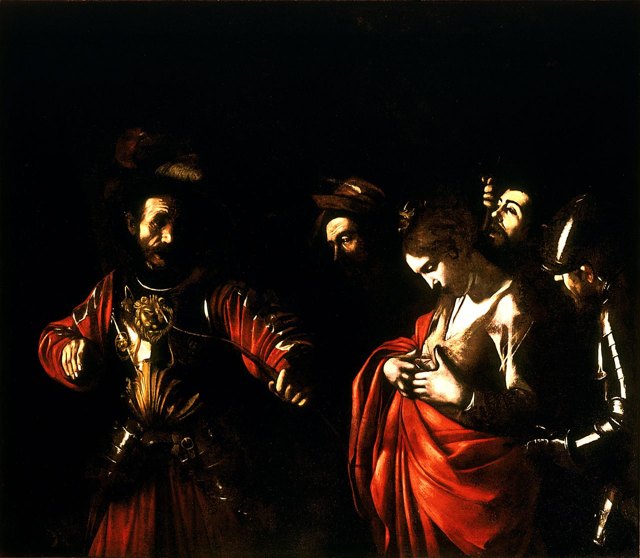
"The Martyrdom of Saint Ursula" is recorded as Caravaggio's final painting. Painted in Naples in 1610, it was followed soon after by the painter's tragic death. For a long time this canvas was believed to be the work of Mattia Preti, a Calabrian painter influenced by Caravaggio, but a document discovered in 1980 restored the attribution to Caravaggio himself. It had been commissioned by the Genoese nobleman Marcantonio Doria.
Caravaggio chose the moment just after the arrow has pierced Ursula's chest. Five figures emerge from the darkness, lit by a single beam of light from the left. The Hunnic king stands with the hand that has just released the arrow still raised, while Ursula, her expression disbelieving, looks down at the arrow with a hand pressed to her chest. And behind her, a man with an anguished face watches the tragedy unfold. It is Caravaggio himself — a final self-portrait of an artist worn down by life, seeming to layer himself over the martyr's suffering.
This painting sank a little deeper into darkness with each passing year, so that lifting away that darkness became an act of recovering something lost. Restoration work in 2003 and 2004 first revealed the silhouette of a figure reaching an arm out between the Hunnic king and Ursula, as if trying to prevent the tragedy. Then in 2025, when restorers Laura Cibrario and Fabiola Jatta cleaned the surface once more in a Naples workshop, three figures long erased by time returned out of the darkness.
Now the painting sits within a special protective enclosure that continuously monitors humidity and temperature, greeting visitors in a new gallery in Naples. People can now look a little more closely at the final brushstrokes Caravaggio ever made.
Lifting away that darkness was an act of recovering something lost.
One Art History Story a Week — on Instagram
See exhibition news and masterwork stories first, in reels and cards.
Instagram · Updated weekly
Curators behind this story
The facts and interpretations in this story are grounded in the public materials of the experts and institutions below. See each original for the full commentary.
- National Gallery of Ireland (scholarly commentary from the holding institution · attribution by Sergio Benedetti) · National Gallery of Ireland, Dublin (Embed + attribution)
- National Gallery of Ireland (collection highlight commentary) · National Gallery of Ireland, Dublin (Embed + attribution)
- James Payne · Great Art Explained (YouTube) (Embed + attribution)
- Museo Nacional del Prado (scholarly commentary from the holding and exhibiting museum) · Museo Nacional del Prado, Madrid (Attribution (museum press release / exhibition commentary))
- Gallerie d'Italia — Napoli (scholarly commentary from the holding museum · Intesa Sanpaolo) · Gallerie d'Italia - Napoli (Intesa Sanpaolo) (Attribution (museum commentary))
- Gallerie d'Italia — Napoli (2025 restoration and reinstallation commentary · conservators Laura Cibrario and Fabiola Jatta) · Gallerie d'Italia - Napoli (Intesa Sanpaolo) (Attribution (museum commentary))
Business Inquiry
Leave your partnership proposal and we'll review and reply.