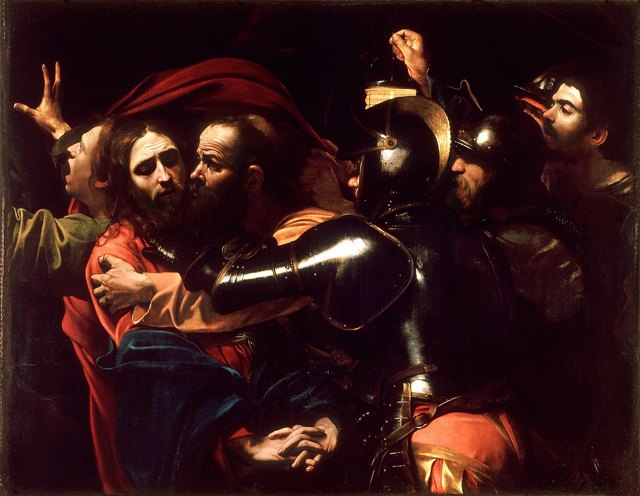
The Taking of Christ
Collection National Gallery of Ireland (on indefinite loan from the Jesuits) · Dublin
The eyes of Jesus hidden in this painting — what secret lies behind them?
Key Points
- Caravaggio's depiction of the arrest of Jesus, with a dramatic contrast of light and shadow
- The kiss of Judas, the sword of the disciple Peter, and the tension of the arrest scene
- The painter's hidden self-portrait within the painting, and the mysterious source of light
- A painting missing for 200 years, kept secret by the Jesuits
Reading the Work
This painting depicts the moment Jesus is arrested through the kiss of his disciple Judas. Jesus stands at the center, Judas kisses him from behind, and Peter holds a sword. Three soldiers and a man holding a lantern also appear in the scene.
The painting is set against a dark background, with light falling sharply to reveal the faces of Jesus and Judas clearly. The light comes from the upper left, and the man holding the lantern at the far right may be a self-portrait of Caravaggio. The gleaming metal on the soldier's arm in the painting is regarded as a mysterious symbol.
In this painting, Caravaggio created a mysterious atmosphere through the dramatic contrast of light and shadow. This technique became a hallmark of Baroque art and vividly conveyed the scene of Jesus's arrest, having a great influence on art history.
One Art History Story a Week — on Instagram
See exhibition news and masterwork stories first, in reels and cards.
Instagram · Updated weekly
Further reading · National Gallery of Ireland · Public domain
Image: Public domain · Wikimedia Commons
Last updated 2026-07-17
Business Inquiry
Leave your partnership proposal and we'll review and reply.