The light painted by a murderer
Michelangelo Merisi da Caravaggio — three paintings completed across years lived as a fugitive
3 chaptersAbout 11 min read
On May 29, 1606, in the Campo Marzio district of Rome, a painter killed a man. His victim's name was Ranuccio Tomassoni; it remains unclear whether the dispute was over a gambling debt or jealousy over a woman. What is certain is that from that day on, a death sentence hung over his name, and a bounty was even placed on him — anyone who recognized him could legally kill him. The painter fled Rome for Naples, then Malta, then Sicily. Even as he fled, he kept painting. The name Caravaggio carried, from then on, two identities at once: murderer and painter. I have decided to trace, in turn, one painting he made before he killed a man, one he made around the time he killed, and one he made as he himself was dying.
Before he killed, he was holding a light
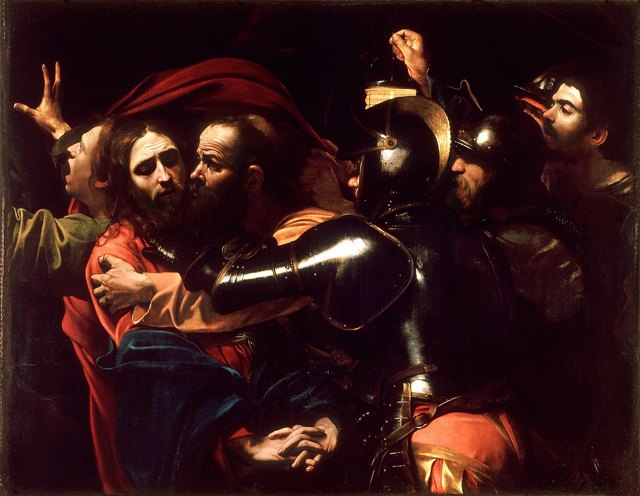
In 1602, the Roman nobleman Ciriaco Mattei commissioned a painting from Caravaggio. It depicts the moment in the Garden of Gethsemane when Judas betrays Jesus with a kiss, as temple guards close in to seize him. The National Gallery of Ireland describes the scene: "Judas identifies Christ with a kiss, and the temple guards close in to arrest him." The figure twisting away in flight on the left is the apostle John, and the light relies on no artificial device, only moonlight. The museum notes: "Moonlight alone illuminates the scene." Caravaggio placed the figures close to the front of the picture plane and used strong chiaroscuro to create a dramatic moment.
At the far right of the painting stands a man holding a lantern. The National Gallery of Ireland explains: "In that man's face, Caravaggio painted himself at thirty-one, as an observer watching the event." He is not at the center of the action. Neither the one seizing nor the one seized, he simply stands to the side, holding up a light. This painting left the Mattei family's hands in 1802. In 1786, Giovanni Bassi mistakenly recorded it as the work of Caravaggio's Dutch follower Gerrit van Honthorst, and under that mistaken label the painting was sold to William Hamilton Nisbet and taken to Scotland. Wikipedia's entry on "The Taking of Christ (Caravaggio)" records: "By the end of the 18th century the painting was believed lost, and its whereabouts remained unknown for about 200 years."
In the 1920s, Irish pediatrician Marie Lea-Wilson purchased this painting without knowing its true identity. After her husband, Captain Percival Lea-Wilson, was killed by the Irish Republican Army in 1920, she donated the painting to the Jesuit community on Leeson Street in Dublin in the early 1930s, as a gesture of gratitude to the Jesuits who had supported her. For nearly thirty years afterward, the painting hung on the dining room wall under the mistaken label of a Honthorst. In 1990, the situation changed when Father Noel Barber, newly appointed as superior, commissioned the painting's restoration. According to Father Barber's recollections published by the Jesuits in Ireland, "Benedetti, an expert in 17th-century Italian painting, saw this painting on Leeson Street and recognized it as, at the very least, an excellent version of a lost Caravaggio." Museum deputy director Dr. Brian Kennedy reportedly said to him: "Noel, sit down. I'm about to tell you something you can't hear standing up." The attribution was confirmed when graduate students Francesca Cappelletti and Laura Testa, working in Rome, found the original commission document in the Mattei family archive in Recanati, and the rediscovery was officially announced in November 1993. Father Barber explains: "The Jesuit community held this painting in charitable trust and had no right to dispose of it as they wished." The painting was placed on indefinite loan to the National Gallery of Ireland in 1993. The museum label still reads: "On indefinite loan to the National Gallery of Ireland from the Jesuit Community, Leeson Street, Dublin, who acknowledge the generosity of the late Dr. Marie Lea-Wilson, 1992."
Noel, sit down. I'm about to tell you something you can't hear standing up.
The summer he was paid for a painting, he picked up a knife
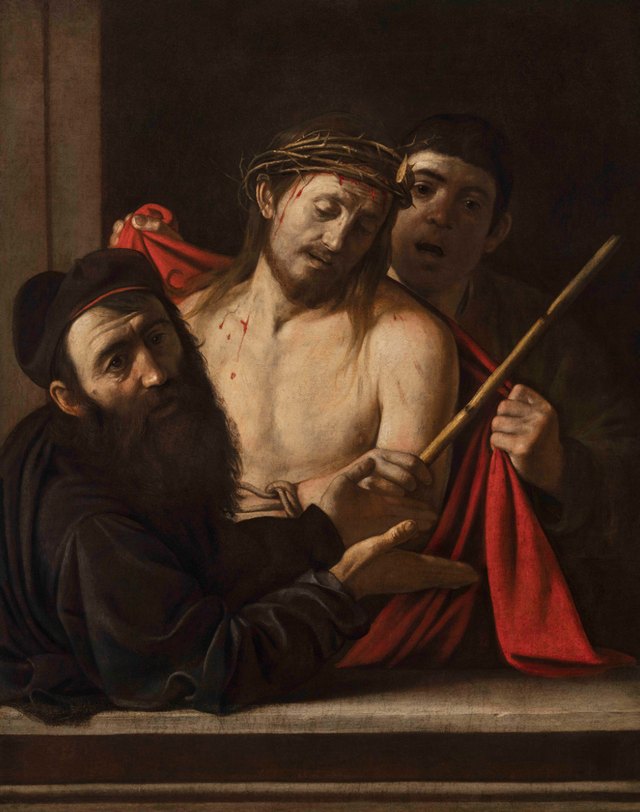
On June 25, 1605, Caravaggio signed a contract with the Roman nobleman Massimo Massimi, agreeing to paint a work of the same size and price as an earlier one he had painted, "Christ Crowned with Thorns." The finished work was "Ecce Homo," its title taken from the words Pilate cried out as he presented the scourged, thorn-crowned Christ before the crowd. Wikipedia's entry on "Ecce Homo (Caravaggio, Madrid)" describes the painting: "Christ is shown bleeding and wearing the crown of thorns. Pilate stands before him, while another man holds a red robe behind Christ." The canvas measures 86 by 111 centimeters, and the contract specified a delivery deadline of early August that year.
The deadline was not met. On the night of July 29, 1605, near the Piazza Navona, Caravaggio struck the notary Mariano Pasqualone with a sword, inflicting a severe head wound, following an argument over his beloved model and lover, Lena. Wikipedia's entry on "Caravaggio" records: "Caravaggio was forced to flee to Genoa for three weeks after seriously wounding the notary Mariano Pasqualone d'Accumoli in a dispute over his model and lover, Lena," and notes that his patrons smoothed over the incident. Having already been paid, and with the painting still unfinished, he spent that summer as a fugitive. The hand that was painting the scourged Christ was, in reality, scourging someone else.
The painting later entered the Spanish royal collection, passing through the residences of Philip IV and Charles II, before at some point disappearing from record once more. In April 2021, it resurfaced at the Ansorena auction house in Madrid. Its estimate was €1,500, and it was listed as a work of the school of Jusepe de Ribera. The Prado Museum alerted Spain's Ministry of Culture, and the auction was halted. Maria Cristina Terzaghi of Roma Tre University and Massimo Pulini of the Bologna Academy of Fine Arts raised the possibility of an authentic attribution, citing the anatomical rendering of Christ, the treatment of light, and the soldier's face. In an interview with The Art Newspaper, Terzaghi said: "The speed with which a consensus formed after its rediscovery that this work was by Caravaggio was unprecedented." After a detailed diagnostic study by nuclear engineer Claudio Falcucci and restoration led by Andrea Cipriani, the painting was hung at the Prado in May 2024. The Prado's press release records the story of its acquisition: "When it resurfaced in April 2021 at the Ansorena auction house, listed as a work of a follower of Jusepe de Ribera, the Prado Museum alerted Spain's Ministry of Culture to the importance of the work." The owner, who has not been publicly identified, has lent the painting to the museum.
The hand that was painting the scourged Christ was, in reality, scourging someone else.
In July, he boarded a boat
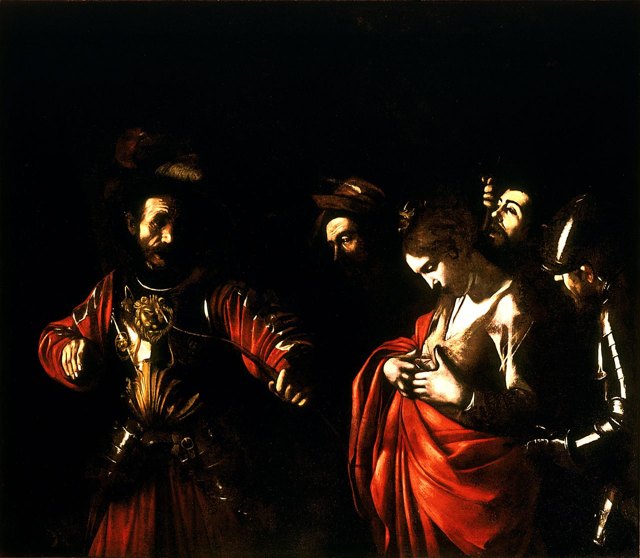
Around May 11, 1610, an agent for the 25-year-old Genoese nobleman Marcantonio Doria reported that a painting had been completed in Naples. It commemorated Doria's stepdaughter's entry into a convent as a nun named Ursula. Saint Ursula was a figure from 4th-century legend who was killed by an arrow after refusing the marriage proposal of a Hunnic king. Gallerie d'Italia Napoli describes this scene as the moment Ursula "gazes at the arrow as the instrument of her martyrdom," her figure marked by "a pallor set against a blood-red cloak." The instant just after the arrow has pierced her chest is what the painting captures. A single beam of light entering from the left draws five figures out of the darkness.
Among the figures is one, standing behind Ursula, whose face looks upward. Gallerie d'Italia describes this figure as "one of those witnessing the drama, his face turned upward, his mouth closed in an expression of anguish," and identifies it as a self-portrait of Caravaggio himself. Wikipedia's entry on "The Martyrdom of Saint Ursula (Caravaggio)" likewise records: "The upturned face behind Ursula is believed to be Caravaggio himself." The painting suffered damage as soon as it was finished. Doria's agent reported that the painting had been set out in the sun the day before to dry the paint quickly, which softened the varnish and damaged the surface, and promised repairs. It was a painting finished in haste.
Two months later, Caravaggio boarded a boat. The same Wikipedia entry records: "In July, he set sail to receive a papal pardon for the killing of a young man in a duel in 1606. But what awaited him was not pardon, but death. The exact cause is unclear, though fever is most often cited, and it occurred at Porto Ercole, on the coast north of Rome." "The Martyrdom of Saint Ursula" thus remained his final completed work. The painting was initially misattributed to Mattia Preti and was only confirmed as Caravaggio's own in 1980. It now hangs at Gallerie d'Italia Napoli, part of the Intesa Sanpaolo collection — together with his final self-portrait, looking upward from behind a woman pierced by an arrow.
But what awaited him was not pardon, but death.
One Art History Story a Week — on Instagram
See exhibition news and masterwork stories first, in reels and cards.
Instagram · Updated weekly
Curators behind this story
The facts and interpretations in this story are grounded in the public materials of the experts and institutions below. See each original for the full commentary.
- National Gallery of Ireland collection commentary (The Taking of Christ) · National Gallery of Ireland (Attribution)
- Fr. Noel Barber's recollection (“Rediscovering a Caravaggio Masterpiece”) · Jesuits Ireland (Attribution)
- “The Taking of Christ (Caravaggio)” entry · Wikipedia (Attribution)
- Museo Nacional del Prado press release (via PR Newswire) · Museo Nacional del Prado (Attribution)
- The Art Newspaper reporting (interviews with Terzaghi and Pulini) · The Art Newspaper (Attribution)
- “Ecce Homo (Caravaggio, Madrid)” entry · Wikipedia (Attribution)
- Gallerie d'Italia — Napoli collection commentary (Martyrdom of Saint Ursula) · Gallerie d'Italia – Napoli (Attribution)
- “The Martyrdom of Saint Ursula (Caravaggio)” entry · Wikipedia (Attribution)
- “Caravaggio” entry (record of the 1606 killing and flight) · Wikipedia (Attribution)
Business Inquiry
Leave your partnership proposal and we'll review and reply.