Who is reflected in the mirror
Diego Velázquez — the threefold gaze within Las Meninas
3 chaptersAbout 7 min read
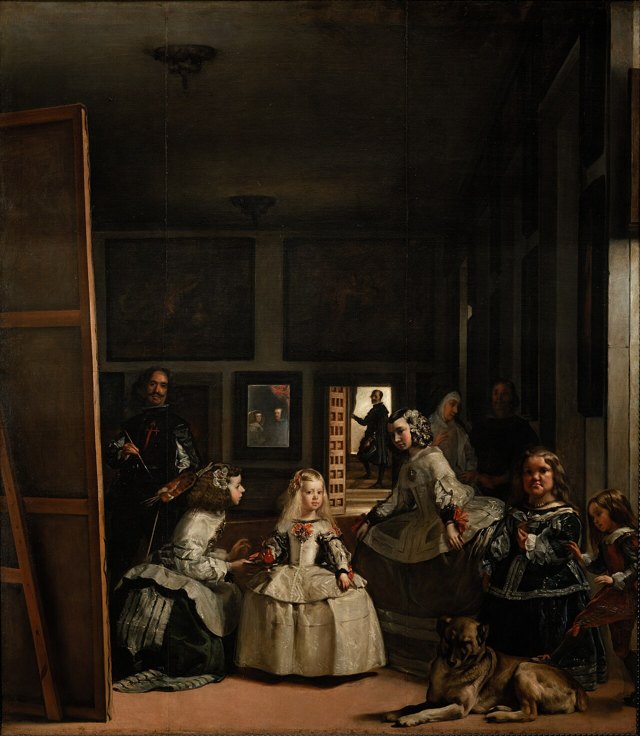
1656, the Prince's Chamber of the Alcázar palace in Madrid. Five-year-old Infanta Margarita Teresa stands surrounded by her ladies-in-waiting, while beside her, the painter stands before a large canvas, brush and palette in hand. The painter is not looking at his canvas but out at us, beyond the frame of the painting. On the back wall, amid other paintings, hangs a small mirror, in which the faint upper bodies of two figures are reflected: King Philip IV of Spain and Queen Mariana. Where do they stand? In the very place where we now stand, or on the canvas the painter is working on? Diego Velázquez's Las Meninas has, for more than 350 years, refused to give a single answer to this question. And on the painter's chest is a red cross — one he was not yet entitled to wear at the moment this painting was completed. I have decided to stand before this painting with three different questions, one after another.
An erased place, two figures in a mirror
The mirror is not large. Tucked among the other paintings on the back wall, it hangs at a size easy to overlook. What it holds is the upper bodies of a man and a woman, two faces cropped at the shoulders. For a long time, scholars have read these as Philip IV and Queen Mariana. The most widely accepted interpretation holds that the king and queen are, at this very moment, standing before Velázquez, posing for a portrait, and that the painting shows the room as seen from that royal couple's own point of view. Under this reading, the spot reflected in the mirror is also the very spot where we, the viewers, now stand. For a moment, we become the King of Spain.
But not every scholar accepts this comfortable conclusion. Art historians H. W. Janson and Joel Snyder proposed a different possibility: that what the mirror reflects is not the king and queen actually standing in the room, but the very canvas Velázquez is painting at that moment — a painting within the painting. Under this reading, we do not stand in the king's place at all; we are merely peering sideways at a portrait the painter is completing. Around the same mirror, the same two faces, interpretations split in entirely opposite directions. Velázquez settles the matter neither way.
What remains, in the end, is uncertainty itself. Whether the king and queen stand beside us, or have pushed us aside and taken our place, debate over this painting has never reached a conclusion. Only one thing is certain: anyone who stands before Las Meninas eventually imagines themselves standing in that spot within the mirror. Generation after generation of viewers has stood in that place, and anyone reading these words will one day face the same question when they stand before it themselves. This may be the only question the painting ever truly asks its viewer: whose eyes are you using to look at this room right now?
Whether the king and queen stand beside us, or have taken our place, the painting never answers.
Looking this way, brush in hand
The painter does not occupy a corner of the picture, but stands claiming the entire left half of the frame. Brush and palette in hand, his body half-hidden behind a massive canvas, yet his face alone turns directly toward us. His gaze is not on the subject he is painting, but on whoever is looking at this painting right now. For a 17th-century court painter to place himself alongside members of the royal family, at the same scale and with the same dignity, was far from common. Velázquez set himself not as background to the painting, but as one of its central pillars.
Art historian Svetlana Alpers reads this choice as an assertion of the painter's own status. By showing himself at work alongside royalty and nobility, Velázquez was claiming a high status both for himself and for the art of painting itself. What he sought to prove was that painting belonged not to the mechanical arts, a skill of the hand, but to the liberal arts, a discipline of the mind. This distinction was far from trivial. The Order of Santiago, which Velázquez so badly wanted to join, barred by its own rules anyone who had worked in a "mechanical" trade. Art historian Madlyn Millner Kahr writes that this painting was an attempt by Velázquez to demonstrate that he was "neither a craftsman nor a merchant, but an official of the court."
His social standing was, in reality, precarious. Spain's rigorous inquiries into purity of blood searched relentlessly for any trace of Jewish or Moorish ancestry, or any history of work in commerce, and in applying to join the order, Velázquez had to claim a higher lineage of minor nobility than he actually possessed. Suspicion lingered that a grandparent may have been a merchant or a converted Jew. Las Meninas, then, is not simply a scene of court life — it is closer to a résumé, condensing the painter's entire career into a single work. The very composition — bringing the king and queen into the painting and placing himself beside them — was already, in itself, a petition.
By placing himself beside the royal portrait, the painter sought to make not the painting, but his own status as a painter, into a masterpiece.
What was painted after the painting was finished
A red cross is clearly visible on Velázquez's chest — the emblem of the Order of Santiago. Yet this painting was completed in 1656, while Velázquez did not actually join that order until November 28, 1659, by royal decree — a full three years after the painting was finished. In effect, the painter appears to have painted an honor onto his own chest before he actually possessed it, and it is here that an old story begins.
Antonio Palomino, who wrote the 18th-century chronicle of Spanish painters, records in 1724 that this cross was ordered painted in by King Philip IV himself, after Velázquez's death. Palomino adds one more line: "Some say the king painted it himself." The story holds that the king personally took up a brush and painted the mark of honor onto the chest of a dead painter. Palomino himself did not record this as established fact, but in the form of hearsay — "some say." It is a story handed down of a king restoring, with his own hand, an honor to a painter whom even the Order of Santiago's own rules had been reluctant to admit.
Whether this story is true remains unsettled even today. But one thing is certain: before Velázquez could, in life, wear that cross with any legitimacy, he had to inflate his own lineage beyond the truth in order to pass the bloodline inquiry, and in the end crossed the order's threshold only through a special dispensation from Pope Alexander VII. It was a place he entered not by passing the rules outright, but by being granted an exception to them. So whether or not the story of the king painting it himself is true, that cross symbolizes an honor granted, from the very start, outside the rules. The story handed down is that the painter within the painting wore, only after death, what he was never able to wear in life.
It is said that the threshold the painter could not cross in life, the painter within the painting crossed only after death.
One Art History Story a Week — on Instagram
See exhibition news and masterwork stories first, in reels and cards.
Instagram · Updated weekly
Curators behind this story
The facts and interpretations in this story are grounded in the public materials of the experts and institutions below. See each original for the full commentary.
- H. W. Janson and Joel Snyder (the alternative reading that the mirror reflects the canvas Velázquez is painting, not the king and queen) · Wikipedia — Las Meninas (Attribution)
- Svetlana Alpers and Madlyn Kahr (the argument on the elevated status of painting and the painter's social rise) · Wikipedia — Las Meninas (Attribution)
- Antonio Palomino, Lives of the Eminent Spanish Painters and Sculptors (1724) — the record that the king had the cross added to the painting after Velázquez's death · Wikipedia — Las Meninas (Attribution)
- Antonio Palomino's account and the circumstances of Velázquez's admission to the Order of Santiago (lineage review and papal dispensation) · Wikipedia — Diego Velázquez (Attribution)
Business Inquiry
Leave your partnership proposal and we'll review and reply.