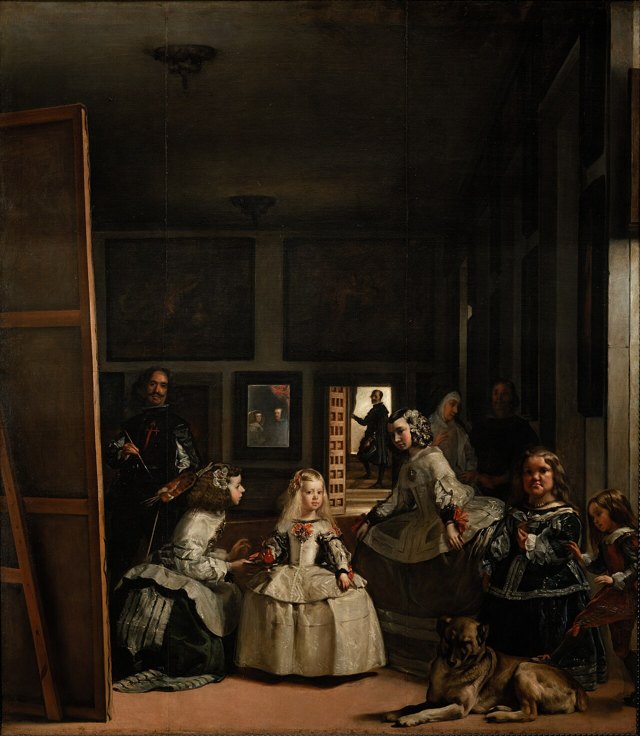
Las Meninas
Collection Prado Museum · Madrid
Did the king and queen hide within the painting?
Key Points
- Royal ladies-in-waiting, a dwarf, a dog, and the painter all gathered in one scene
- The painter's distinctive gaze, looking directly at the viewer
- The king and queen in the mirror cross the boundary between reality and illusion
- 1656: art history's greatest riddle, containing a secret of the royal court
Reading the Work
In this painting, the five-year-old Infanta Margarita Teresa appears together with her ladies-in-waiting, a dwarf, a dog, and the painter Velázquez himself. She is attended by two ladies-in-waiting, with a dwarf and a dog behind her. Velázquez looks toward the canvas, preparing to paint.
Velázquez used rich color and subtle lighting to bring the scene vividly to life. In particular, the reflection of the king and queen in the mirror blurs the boundary between reality and the painting. The gazes of the figures are directed at the viewer, and their movement and expressions give the scene a sense of life.
This painting is famous for its distinctive composition, which questions the relationship between reality and illusion, and between the observer and the figures within the painting. Art historians regard it as a masterpiece exploring the very essence of painting. The mirror within the painting is seen as a symbol that crosses the boundary between reality and art.
One Art History Story a Week — on Instagram
See exhibition news and masterwork stories first, in reels and cards.
Instagram · Updated weekly
Further reading · Smarthistory · CC BY-NC-SA 4.0
Image: Public domain · Wikimedia Commons
Last updated 2026-07-17
Business Inquiry
Leave your partnership proposal and we'll review and reply.