The lineage of the white box
Bauhaus, Ulm, Braun, Apple — one design principle that crossed a hundred years
7 chaptersAbout 11 min read
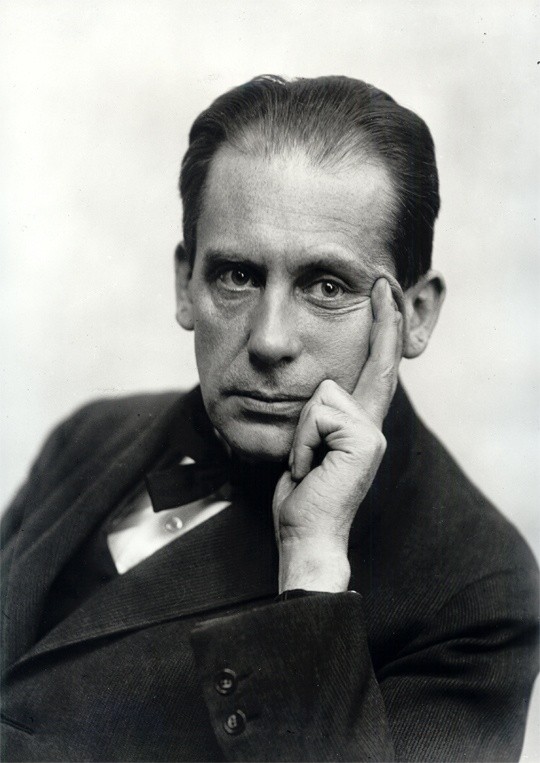
In 1919, in Weimar, Walter Gropius wrote a single manifesto. It was little more than a call to unite art and craft — the word "function" did not even appear in it. That school was shut down by the Nazis, and its principles scattered along with its people. Twenty years later, in Ulm, the older sister of a brother and sister executed for their resistance movement rebuilt that principle from the ground up. And a young designer, at an appliance company called Braun, made a handful of white radios and calculators. Half a century later, those white boxes resurfaced in the white earbuds and calculator app icon of a company called Apple. From a single manifesto to a device in the palm of a hand, we trace back the distance one principle traveled.
A manifesto shaped like a cathedral
April 1919, Weimar. Architect Walter Gropius merges the Academy of Fine Arts and the School of Arts and Crafts to establish the Staatliches Bauhaus. The manifesto's cover was a woodcut engraved by the painter Lyonel Feininger: a cathedral with three sharp spires radiating beams of light. In this manifesto, Gropius called for sculpture, painting, applied art, and craft to be reunited into a single guild without class distinctions — for the wall dividing art and craft to be torn down, and for both to move forward together toward a new architecture.
One interesting fact: the word "function" appears nowhere in this manifesto. The industrial functionalism people would later come to call "Bauhaus-like" — stripping away ornament to focus purely on use — is not yet present in this 1919 document. The first manifesto reads, if anything, closer to Expressionist and Romantic language. It was only some years later that the school actually turned toward function and mass production. The white walls, glass, and unadorned forms we now associate with the name "Bauhaus" were not born at the moment of its founding, but made afterward.
The manifesto called for uniting art and craft into a single guild, but never once used the word "function."
The door the Gestapo closed

The Bauhaus moved from Weimar to Dessau in 1925, settling into this glass-and-concrete building designed by Gropius. But in 1931, the Nazi Party won a majority on the Dessau city council, and pressure to close the school began the following year. The Nazis attacked the Bauhaus as a hotbed of "degenerate art," a den of Jewish and internationalist left-wing intellectuals. In late 1932, then-director Mies van der Rohe rented an old factory building in Berlin with his own money and continued the school privately. For ten months, classes continued without major interference.
But on April 11, 1933, Berlin police, acting on orders from the new Nazi government, closed even that building. Fourteen years after its founding, the Bauhaus effectively vanished, dressed in the formality of a self-closure. Its professors and students scattered to the United States, Switzerland, Israel, and elsewhere, and only the principles they had taught spread out across the world. The school as a physical body disappeared, but its principle did not.
The school as a body disappeared, but as its people scattered, its principle did not disappear with it.
After the closure, again in Ulm
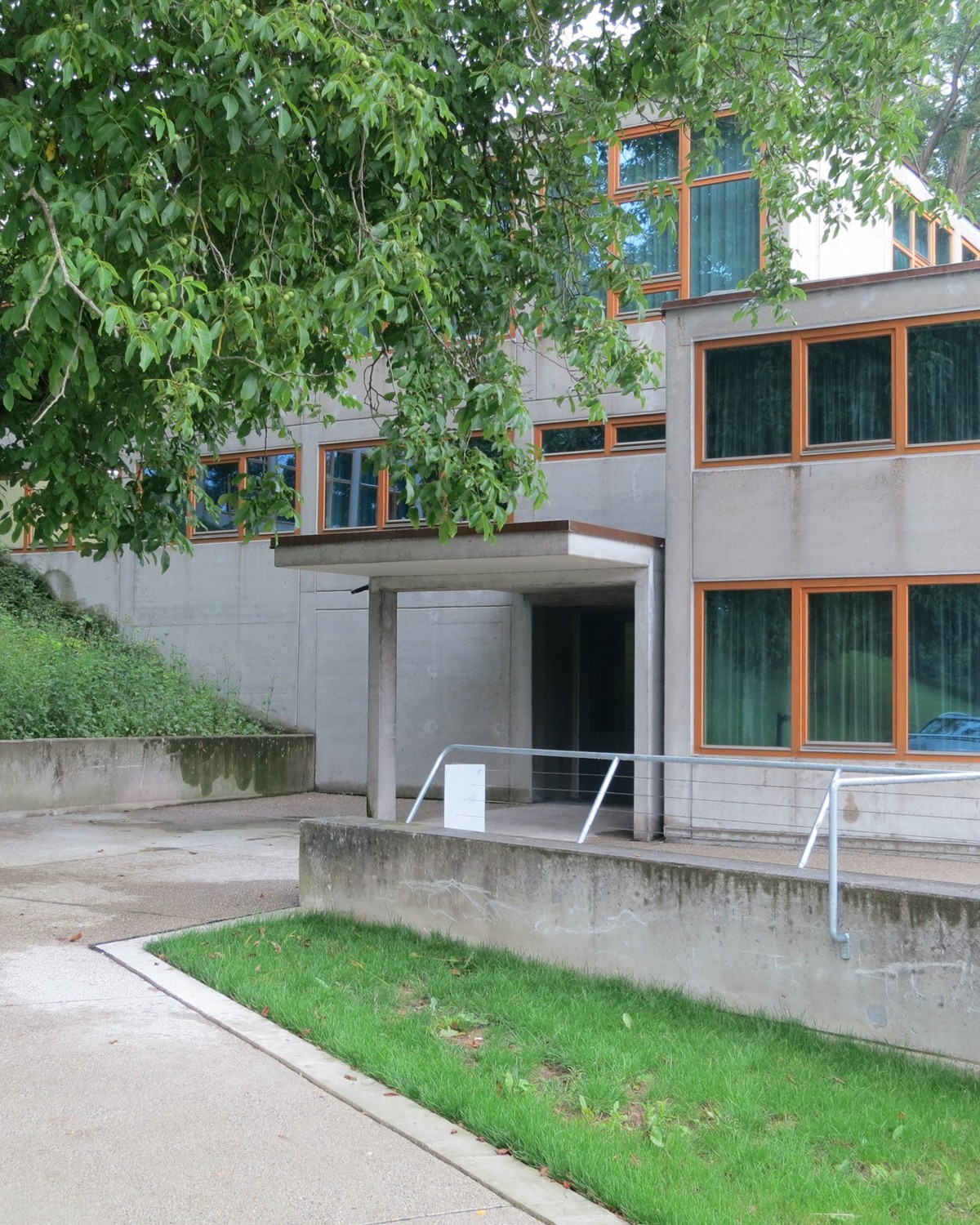
In 1953, twenty years after the Bauhaus's closure, a new design school opened its doors in Ulm, Germany. It was founded by Inge Aicher-Scholl, her husband Otl Aicher, and Max Bill, who had trained at the Bauhaus. Inge Aicher-Scholl carried an extraordinary personal history: she was the older sister of Hans Scholl and Sophie Scholl, siblings executed for resisting the Nazis. She was also the author of the first book on the White Rose resistance movement, published in 1952, and it fell to her to hold the school's finances together to the very end. Max Bill served as founding director and even designed the school's building himself, completed in 1955.
Ulm did not consider itself a simple reenactment of the Bauhaus. It is regarded as a school that took the Bauhaus's project of uniting art, craft, and technology and radicalized it into a far more rigorous methodology, drawing in sociology, psychology, and systems theory. And in 1955, Hans Gugelot designed a new product for Braun together with Ulm students, drawing attention at the Düsseldorf Radio Fair. It was the moment the principle crossed over from the Bauhaus to Ulm, and from Ulm to an appliance company. This school, too, did not last long. In 1968, when state funding was cut off, it closed after just fifteen years. Like the Bauhaus before it, Ulm too vanished under political pressure.
Ulm was not a reenactment of the Bauhaus, but a school that radicalized its principles by drawing in sociology and systems theory as well.
A 23-year-old interior designer
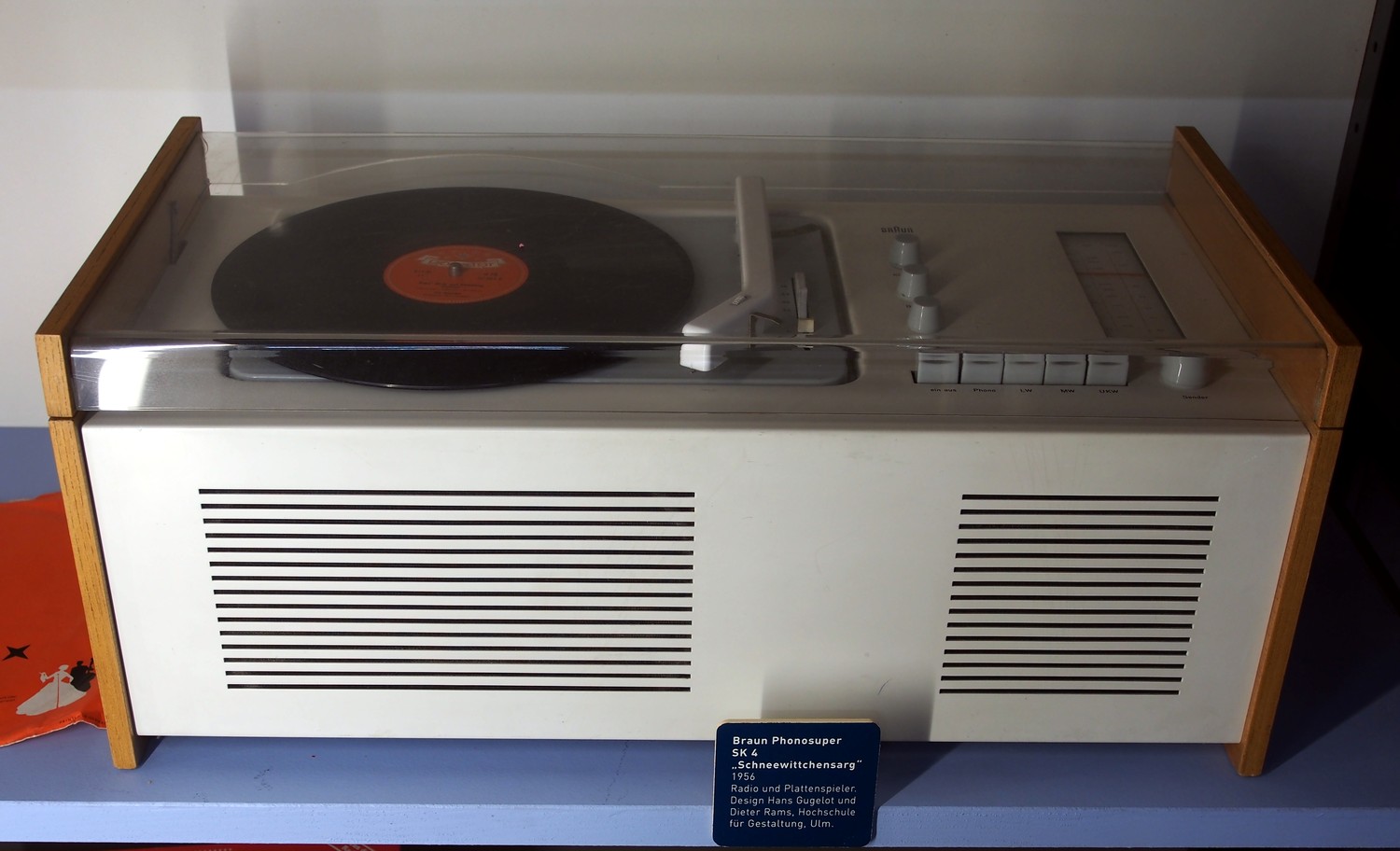
In 1955, 23-year-old Dieter Rams joined Braun as an architect and interior designer. His first assignment was not product design at all, but reworking office spaces and showrooms to fit the company's new design direction. At the time, Braun was partnering with the Ulm School of Design to overhaul its entire product language. The following year, in 1956, Rams, together with Hans Gugelot and Wilhelm Wagenfeld, released the SK4, a radio and turntable combined into a single unit.
The original design called for a metal lid, but it rattled whenever the volume was turned up. Rams proposed replacing the lid with acrylic, a material that had only just become available, and the result was a radio whose transparent cover let the record show through underneath. People nicknamed this transparent, coffin-like form "Snow White's Coffin." The exhibition label on the object now held by the Museum of Modern Art in New York reads: "Design: Hans Gugelot and Dieter Rams, Ulm School of Design." It was the first moment Ulm's name was engraved side by side with a Braun product.
A single material chosen to eliminate a rattling sound left the radio with the nickname "Snow White's Coffin."
A radio in a pocket
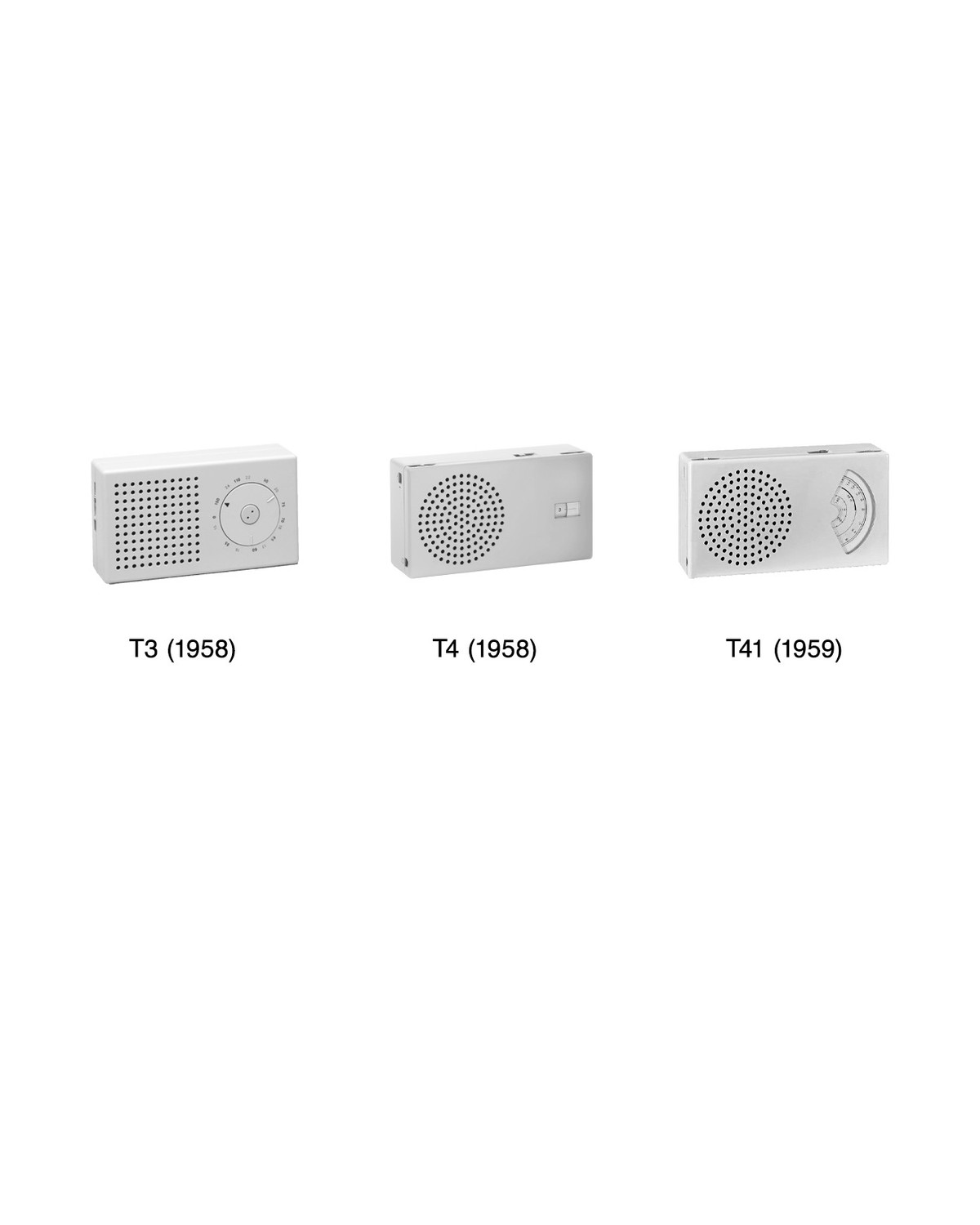
In 1958, Braun released the T3, the first pocket-sized transistor radio. MoMA's collection credit reads: "Dieter Rams, Ulm School of Design, Germany." This is a credit listing not just the name of a Braun designer, but the school itself alongside him. The following years brought sibling models, the T4 and the T41. All three shared the same visual grammar: a white body, a circular dial, and a grid-patterned speaker grille.
In 1961, six years after joining the company, Rams became Braun's chief design officer. Then, in the late 1970s, he looked back at the world he inhabited and asked himself a question: "Is my design really good design?" The world he saw was one where "form, color, and noise" had become impenetrably tangled together, and he recognized that he himself was contributing to that chaos. In December 1976, he gave a lecture at Vitsœ in New York addressing this concern. The thinking refined there would later be distilled into what became known as "Ten Principles for Good Design." At its foundation lay the phrase "Weniger, aber besser" — "Less, but better." Rams is said to have heard this phrase from his grandfather, a carpenter.
Less, but better — a phrase from a carpenter grandfather became a principle for his designer grandson.
A philosophy that survives in a single calculator
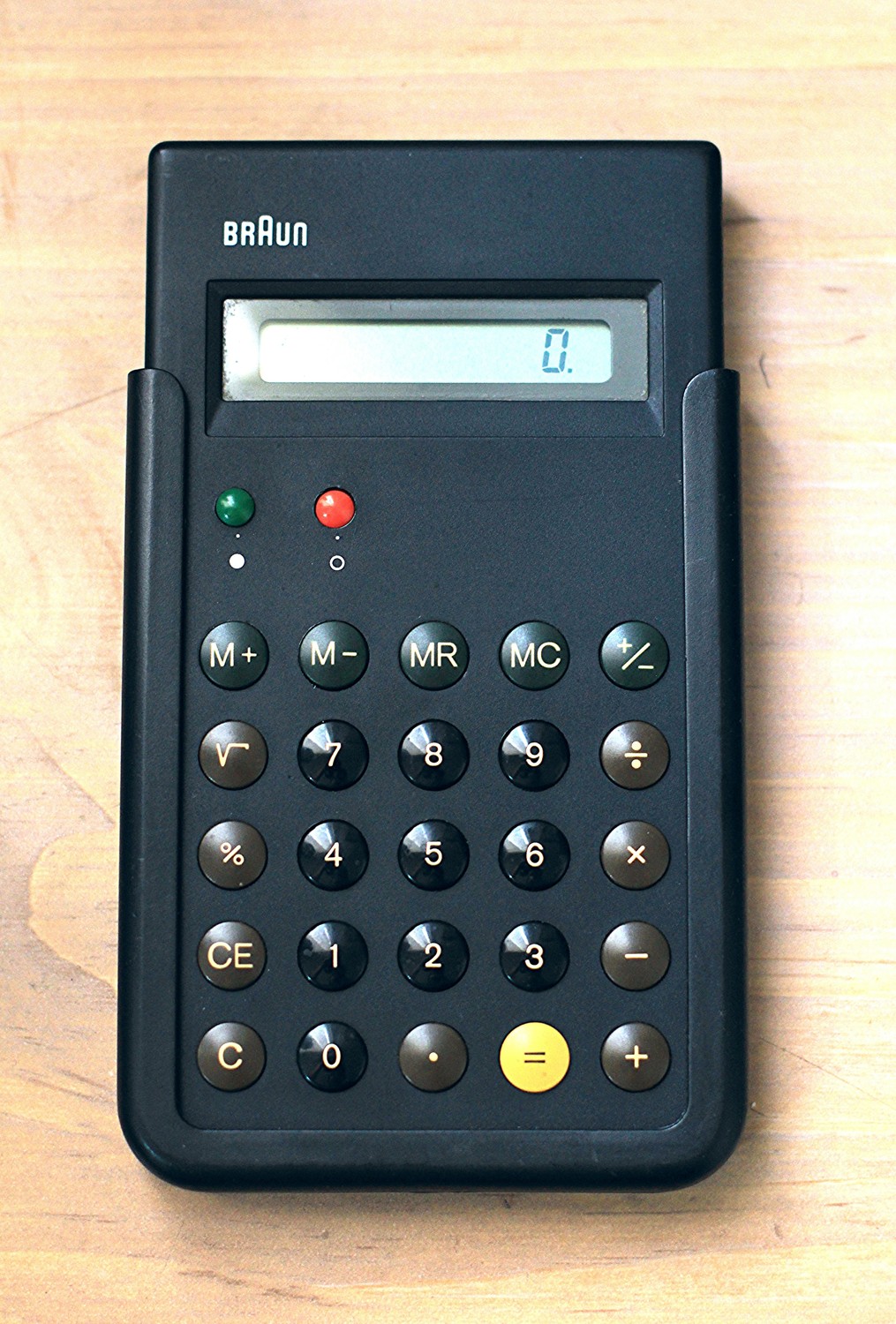
In 1987, Rams, together with fellow designer Dietrich Lubs, created the ET66 calculator. It featured a black body with round buttons, numbers in black, operator symbols in brown, and only the "=" button set apart in yellow. There was no ornament — every point a finger touched had a reason to be there. This calculator is still cited as one of the most compact demonstrations of the "less, but better" principle, and is held today in the collection of London's Victoria and Albert Museum.
Klaus Klemp, design curator at the Museum of Applied Arts in Frankfurt, points to Braun products like this one as proof that designs made half a century ago still hold up today. The conditions he lists are: durable, easy to use, self-explanatory, environmentally friendly, and above all, deeply appealing. The ET66 was an object that met those conditions within the 20th century. And more than twenty years later, several media outlets pointed out that the button layout and color contrast of this calculator bore a striking resemblance to the iPhone's calculator app. The design of the iPhone calculator app was gradually revised afterward, but by then, the initial resemblance had already been widely discussed.
A stripped-down calculator resurfaced, more than twenty years later, as an icon on another company's screen.
Back to the white box, again
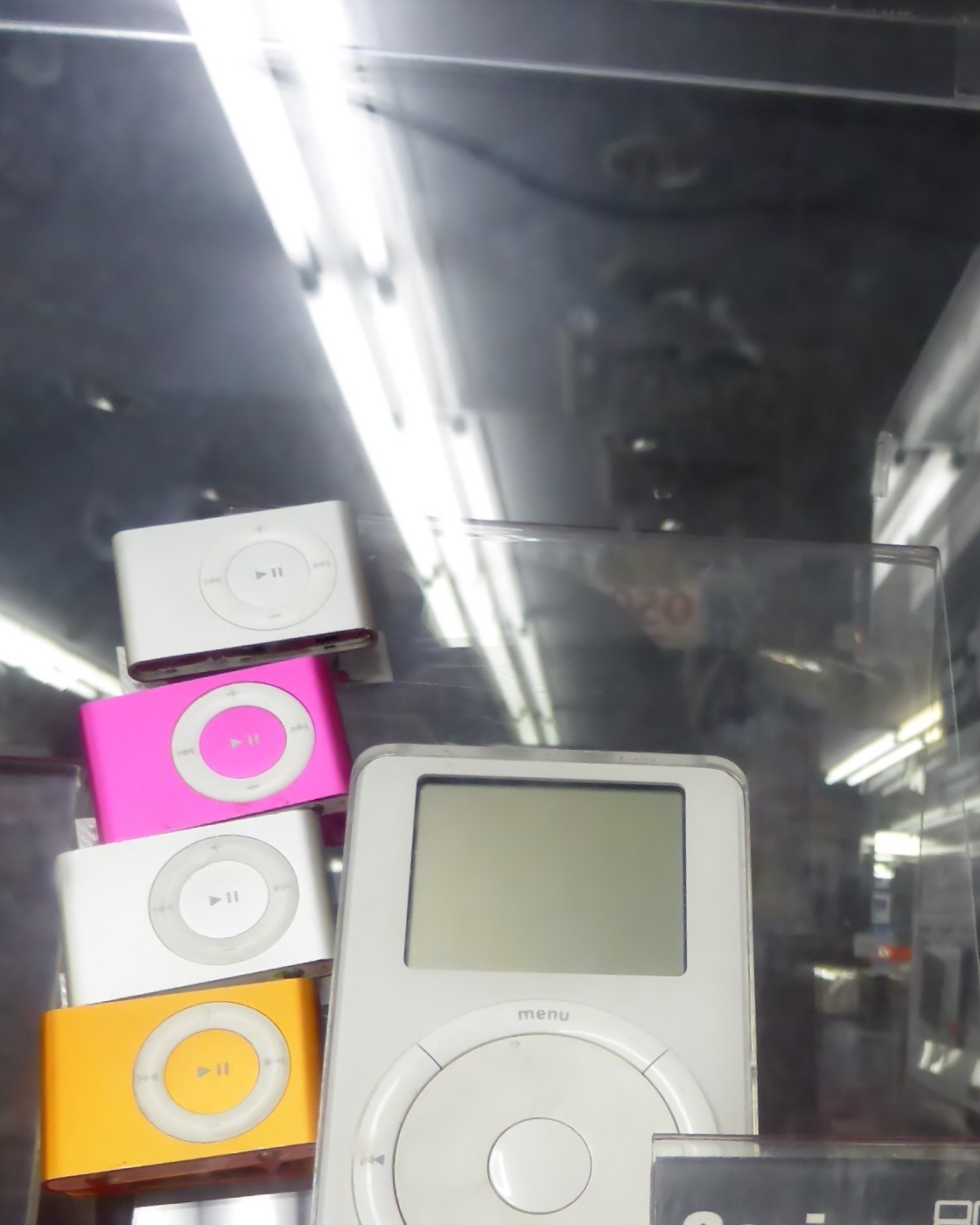
The iPod, released by Apple in 2001, is often said to evoke the T3 with its white body and circular dial. But strictly speaking, the story is a little more complicated. According to reporting, the very operating concept of scrolling through a menu with a click wheel came from the Bang & Olufsen Beocom 6000 telephone, which Apple marketing executive Phil Schiller had taken note of. What was inherited from the T3 was not the mechanics of the wheel, but rather the attitude of a white box stripped of ornament. This first-generation iPod is now held at the Museum of Modern Art in New York, credited to "Jonathan Ive, Apple Industrial Design Team, 2001."
In the foreword to Sophie Lovell's official biography of Rams, Ive recalled that the first Braun product to enter his parents' home was a Citromatic juicer. He described the consistency with which Rams embodied his philosophy across such an enormous range of products as "breathtaking." Rams responded in kind. In the 2009 documentary "Objectified," he named Apple as one of the few companies designing according to his ten principles. In a 2011 interview ahead of a new book's publication, he said: "Apple has achieved what I never managed to — making people line up to buy something purely because of the power of the product. I had to line up for rations after the Second World War." In 2018, director Gary Hustwit made the feature-length documentary "Rams," with music by Brian Eno. The film captured not only his connection to Apple, but also the concerns about overconsumption that Rams himself had long carried. A single principle, born in Weimar, arrived nearly a hundred years later inside a device that fits in the palm of a hand.
Apple has achieved what I never managed to. I had to line up for rations after the war.
One Art History Story a Week — on Instagram
See exhibition news and masterwork stories first, in reels and cards.
Instagram · Updated weekly
Curators behind this story
The facts and interpretations in this story are grounded in the public materials of the experts and institutions below. See each original for the full commentary.
- Dezeen — Walter Gropius: the ideas man who founded the Bauhaus school · Dezeen (Attribution)
- The Bauhaus: The Idea Behind the School and Its Educational Programme · Bauhaus-Archiv / Museum für Gestaltung (Attribution)
- Wikipedia — Bauhaus (the Nazi Party's majority win in the Dessau city council and the school's closure in April 1933) · Wikipedia (Attribution)
- The Bauhaus in Exile: What Happened After its Closure in 1933 · Bauhaus-Archiv / Museum für Gestaltung (Attribution)
- Wikipedia — Ulm School of Design · Wikipedia (Attribution)
- Ulm school: The methodological revolution of design (1953-1968) · Hart Design Selection (Attribution)
- Wikipedia — Inge Scholl (the White Rose resistance movement and the founding of the HfG Ulm) · Wikipedia (Attribution)
- Hans Gugelot. The Architecture of Design at the HfG-Archiv, Ulm · smow Blog (Attribution)
- MoMA — Dieter Rams, Hans Gugelot. Radio-Phonograph (model SK 4/10). 1956 · MoMA (Attribution)
- Snow White's Coffin SK4 designed by Rams, Gugelot and Wagenfeld · Braun Audio (Attribution)
- Wikipedia — Dieter Rams (joining Braun in 1955 and becoming chief designer in 1961) · Wikipedia (Attribution)
- MoMA — Dieter Rams, Hochschule für Gestaltung, Ulm, Germany. Pocket Radio (model T3). 1958 · MoMA (Attribution)
- What is 'Good' Design? A quick look at Dieter Rams' Ten Principles. · Design Museum (London) (Attribution)
- Good design — the origin of 'Weniger, aber besser' · Vitsœ (Attribution)
- V&A — ET66 Calculator | Dietrich Lubs | Dieter Rams · Victoria and Albert Museum (Attribution)
- Interview with Prof. Dr. Klaus Klemp on the work of Dieter Rams · Stylepark (Attribution)
- Iconic calculator that inspired an iPhone app is re-released · Creative Bloq (Attribution)
- MoMA — Jonathan Ive, Apple Industrial Design Group. iPod. 2001 · MoMA (Attribution)
- Apple's Inspiration For The iPod? Bang & Olufsen, Not Braun · Fast Company (Attribution)
- Jonathan Ive interview — recalling the Citromatic MPZ2 and calling it 'breathtaking' · rams-foundation.org (Attribution)
- An Apple Inspiration (citing a 2011 interview with Rams) · Cooper Hewitt, Smithsonian Design Museum (Attribution)
- 'Apple has achieved something I never did' - Dieter Rams · Dezeen (Attribution)
- Rams (2018 film) — directed by Gary Hustwit · Wikipedia / hustwit.com (Attribution)
Business Inquiry
Leave your partnership proposal and we'll review and reply.