Waves and mountains, and an old man who kept painting until ninety
Katsushika Hokusai — the moments captured in "Thirty-six Views of Mount Fuji"
3 chaptersAbout 8 min read
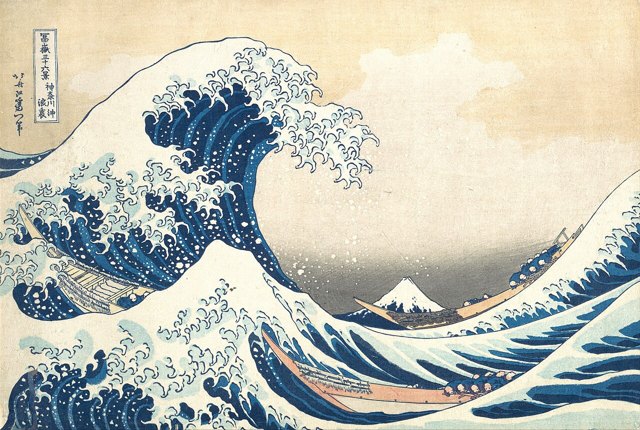
There once was an old man. He wrote that only at seventy-three had he begun to grasp a little of the true structure of birds, fish, and grass. At ninety, he said, he would dig deeper into the secrets of things, and at a hundred, he would finally reach a marvelous realm. It is a strange sentence. At an age when most painters speak of completion, Hokusai says he has not yet begun. "Thirty-six Views of Mount Fuji" is the series he made around the age of seventy: there are waves, there is a mountain, and before them, a human figure rendered very small. Because it was printed from woodblocks onto color, thousands of impressions were made, and today they hang scattered across museums in New York, London, and Boston. That the same image exists simultaneously in many places may itself have been the kind of permanence he wanted. I have decided to stand, in turn, before three of these prints.
A wave on the verge of falling
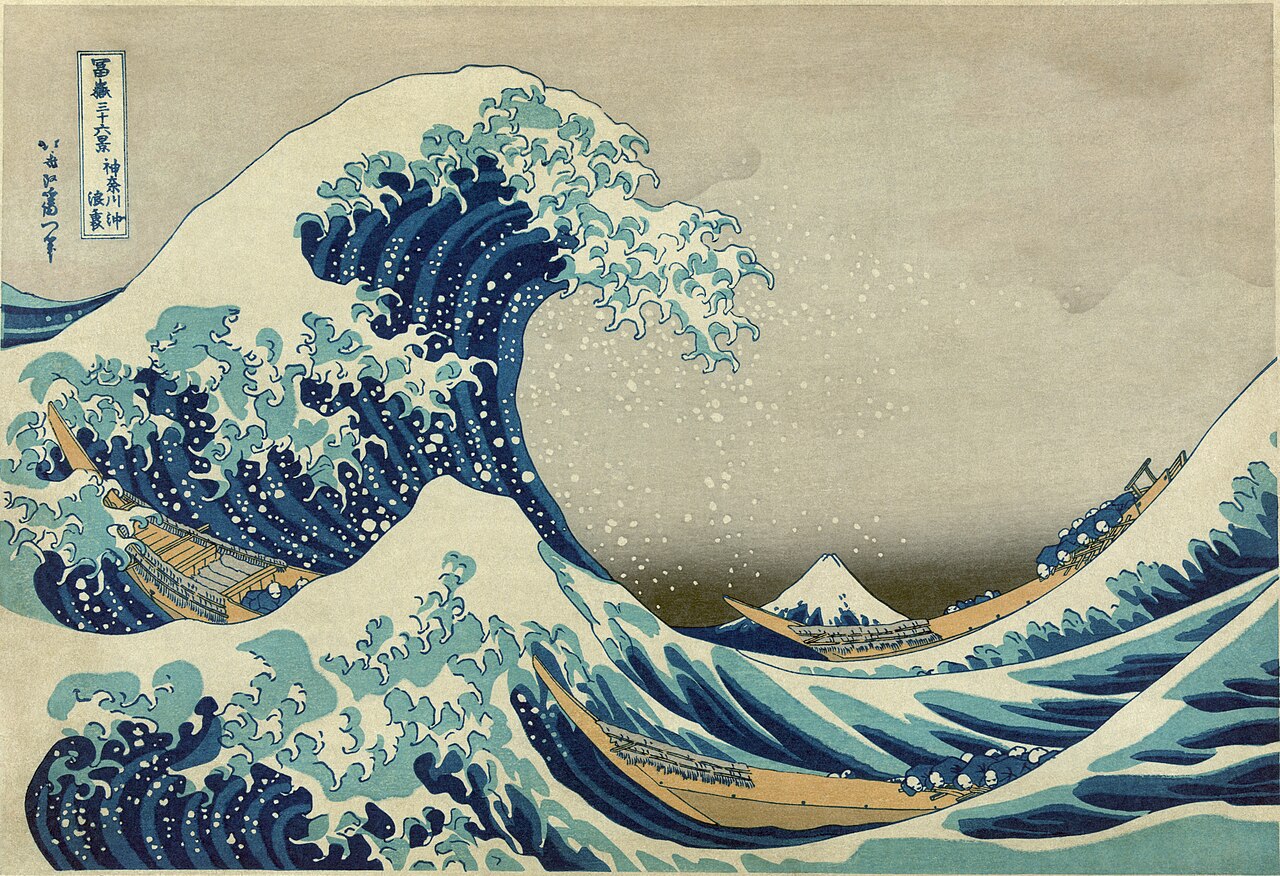
The wave has not yet broken. That alone could be said to be the whole of this painting. A massive crest rises high into the sky and hangs suspended, its spray splayed downward like fingers. Smarthistory describes this scene as "the moment just before the wave crashes down on three fishing boats." The image remains forever in that instant just before. A wave that never breaks. A catastrophe that never arrives. Look at this painting long enough, and you realize this suspension feels closer to stillness than to threat.
On the boats, the men crouch low. The mountain sits far off, made small by perspective, nestled between the troughs of the wave. Smarthistory notes that through the use of perspective, Mount Fuji is made to look "small, as if it might be swallowed by the wave." The largest thing and the smallest thing trade places within a single frame. This inversion — where the wave before our eyes looms larger than a sacred mountain — is, oddly, reassuring. In the world, what is near always eclipses what is far.
We must talk about the color. This blue came from Europe: Prussian blue, a synthetic pigment that did not become available in Japan until the 1820s. The Metropolitan Museum's scientific research team performed spectral analysis on its holdings and found that the printers did not use this new blue on its own, but layered it carefully together with traditional indigo. In the first printing block, Prussian blue was mixed with indigo; in the second, pure Prussian blue was laid on top to create a more subtle depth. What looks, at a glance, like a single layer of blue is, in fact, blue printed twice.
And the West is present here too. Smarthistory points out that, even during a period when Japan's trade was heavily restricted, this print shows the influence of Dutch art. A painter in a closed country painted the most famous wave in the world by the light seeping through a crack in the door. And that wave then crossed the sea again, becoming an inspiration for 19th-century European painters. Pigment traveled from west to east; the image traveled from east to west.
A wave that never breaks. A catastrophe that never arrives. This suspension feels closer to stillness than to threat.
The morning a red mountain appears
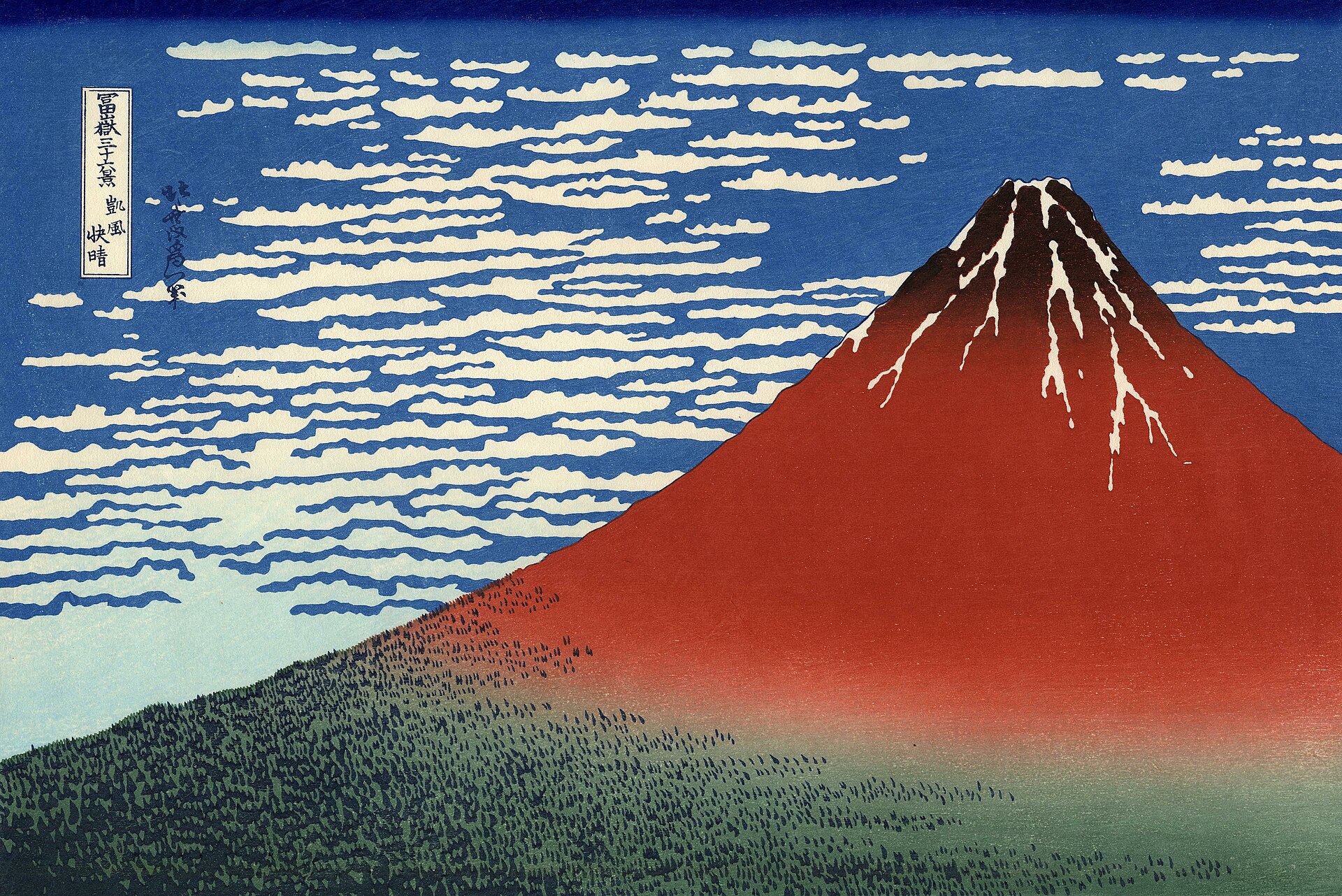
After the wave comes stillness. "Fine Wind, Clear Morning," commonly called "Red Fuji," has no wave, no boat, no person. Only a single mountain stands, occupying two-thirds of the frame. Its slopes spread from red into indigo, a green tree line runs below, and mackerel clouds scatter above. The color is extremely restrained, and yet Mount Fuji's overwhelming presence is not diminished in the slightest.
This red is not a symbol, but a moment in time. Various commentaries explain that this print captures a very specific climatic instant — a narrow window of time in early morning when the low sun warms the mountain's slope while the sky above is still cold. The red is not an idea imposed upon the mountain; it is a marker that this scene belongs to a brief span within a single day. A little later, this red will vanish. So this is not a portrait of a mountain, but a portrait of a particular morning.
The British Museum holds this print and records it as a color woodblock depicting Mount Fuji under clear skies. Clouds part, leaving a halo-like space around the summit, while patches of remaining snow contrast with the lower slopes still sunk in shadow. Fewer than ten complete sets of the "Thirty-six Views of Mount Fuji" exist in the world, and the most significant of them are divided among the Metropolitan Museum, the Museum of Fine Arts Boston, the British Museum, and the Bibliothèque nationale de France.
To Hokusai, Mount Fuji was never merely scenery. An essay by Gary Hickey published by the National Gallery of Victoria notes that Hokusai regarded Mount Fuji as a symbol of immortality and a sacred mountain representing spiritual transcendence, an idea likely rooted in Chinese Taoist tradition and Japanese mountain worship. An old man who declared he would live to a hundred and reach a marvelous realm painted this undying mountain again and again. That is unlikely to be a coincidence.
This is not a portrait of a mountain, but a portrait of a particular morning. A little later, this red will vanish.
"At ninety," he wrote
"Thirty-six Views of Mount Fuji," despite its title, did not stop at thirty-six prints. As its popularity grew, ten more were added, bringing the total to forty-six. Hokusai never viewed the mountain from a single direction. Beyond a wave, from a field, beneath a bridge, between the roofs of craftsmen's workshops — he painted the same mountain again and again, each time from a different vantage point. This relentless repetition of a single subject from many angles feels less like an attempt to possess the subject than an attempt to approach it. From no direction is Mount Fuji ever fully captured.
By the time he made this series, Hokusai was already past seventy. Various sources report that he created these images in his seventies, at the very peak of his career. And he called himself "Gakyo Rojin" — the old man mad about painting. At seventy-five, in the afterword to the first volume of "One Hundred Views of Mount Fuji," he left behind a now-famous statement. The exact wording varies by translation, but the gist is always the same: nothing he painted before the age of seventy is worth looking at; only at seventy-three did he begin to grasp a little of the structure of things; at ninety he will dig deeper into their secrets; and at a hundred he will finally reach a truly marvelous realm.
The British Museum presents this afterword as his artistic manifesto, noting that he gave himself a new name, "Manji," and expressed a longing for completion and immortality. Hickey's essay quotes the same passage: "At ninety I shall have penetrated to the essential nature of things, and at one hundred I shall have reached a marvelous stage." This is not bravado. It is a confession that he had not yet learned, and a list of reasons to keep living.
Hokusai kept painting until his nineties and died at eighty-eight or ninety. The promise that at a hundred and ten every dot and every line would come alive on its own was never fulfilled. But the wave he left behind still never finishes breaking, and the red mountain he painted still holds the light of some particular morning. Prints struck from a single woodblock, scattered across many countries, remain alive simultaneously in many places. Perhaps this is the very form of immortality he meant: that even after one hand has stopped moving, the wave that hand painted keeps forever hovering just before it breaks.
It is a confession that he had not yet learned, and a list of reasons to keep living.
One Art History Story a Week — on Instagram
See exhibition news and masterwork stories first, in reels and cards.
Instagram · Updated weekly
Curators behind this story
The facts and interpretations in this story are grounded in the public materials of the experts and institutions below. See each original for the full commentary.
- Leila Anne Harris · Smarthistory (Attribution)
- The Metropolitan Museum of Art scientific research team (essay “The Great Wave: Anatomy of an Icon”) · The Metropolitan Museum of Art (Attribution)
- The British Museum collection commentary (Thirty-six Views of Mount Fuji prints) · The British Museum (Attribution)
- Gary Hickey, “The Old Man, Mount Fuji and the Sea” · National Gallery of Victoria (NGV), Art Journal 44 (Attribution)
- The British Museum commentary on “Hokusai: Beyond the Great Wave” (published via Nippon.com) · The British Museum (Attribution)
Business Inquiry
Leave your partnership proposal and we'll review and reply.