Under the Wave off Kanagawa
Under the Wave off Kanagawa (The Great Wave, 神奈川沖浪裏)
Collection Metropolitan Museum of Art (and other collections) · New YorkMuseum info & exhibitions →
The moment the wave nearly swallowed the men, Mount Fuji stands silent
Key Points
- A scene capturing the moment a wave seems about to swallow the men
- A dramatic composition contrasting Mount Fuji and the wave
- The pinnacle of 19th-century Japanese printmaking
- A work that had a great influence on European artists
Reading the Work
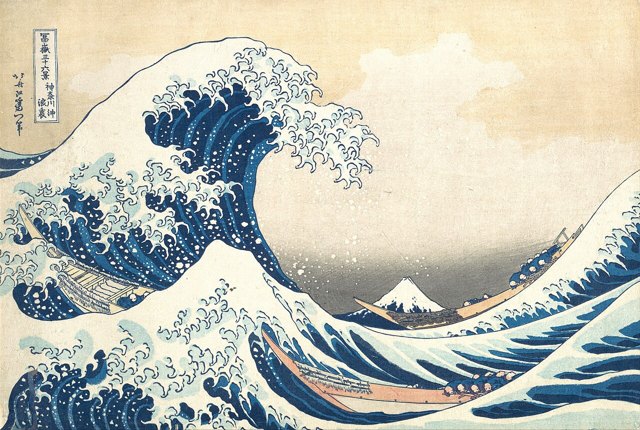
This painting depicts a massive wave crashing over the sea, with three boats about to be engulfed by it. The wave's height is estimated at about 10 to 12 meters, and its crest, frozen at its peak, looks like sharp claws. About 30 passengers are aboard the boats, all depicted rigid with fear of the wave's threat. Behind them, snow-capped Mount Fuji stands calmly.
The wave forms a layered, spiral structure, with the spray and foam vividly rendered. Mount Fuji is drawn small, creating a contrast with the wave. The wave is a deep blue, while the white snow of Mount Fuji emphasizes the stillness of the scene. This work uses the "bokashi" technique, wiping away a little pigment to create a soft gradation, making the flow of nature feel even more vivid.
This work emphasizes the power of nature and the smallness of humanity, representing the pinnacle of nature-centered landscape printmaking. It was the first attempt in 19th-century Japanese printmaking to take nature as its central subject, and it later had a great influence on European artists. In particular, the Impressionist painter Van Gogh praised this work highly, and it has become one of the most famous works of Japanese art in world art history.
One Art History Story a Week — on Instagram
See exhibition news and masterwork stories first, in reels and cards.
Instagram · Updated weekly
Further reading · Smarthistory · CC BY-NC-SA 4.0
Image: Public domain · Wikimedia Commons
Last updated 2026-07-17
Business Inquiry
Leave your partnership proposal and we'll review and reply.