A Portrait of Broken Things — Frida Kahlo
Three self-portraits painted with a broken body as evidence
3 chaptersAbout 7 min read
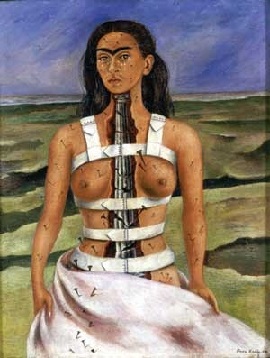
One afternoon in September 1925, a bus collided with a streetcar in Mexico City. Eighteen-year-old Frida Kahlo was impaled through the pelvis by a steel handrail, and her spine was broken in three places. From that day, her body became the stage for more than twenty surgeries over her lifetime, along with steel corsets and plaster casts. What is fascinating is that she never hid this body. Instead, she placed it at the very center of the canvas and made us look directly at it. Kahlo's self-portraits are less confession than evidence — a voice that says: here was pain, and I looked at it exactly as it was. She is an artist easily mythologized, but today we will speak only of three works with clear provenance and real scholarly commentary: The Broken Column, the divided self of two selves, and the dead hummingbird hung around her neck.
Where the spine should be, a collapsing column stands
In 1944, Kahlo underwent spinal surgery, one of many operations meant to correct the lasting effects of the accident she suffered at eighteen. While recovering, she painted herself on a small Masonite panel measuring less than 40 by 40 centimeters. Her torso is split open, and through the crack, in the place where her spine should be, stands an Ionic column. It is not whole — it is cracked in several places and looks as though it is about to collapse.
What holds her body together is a steel orthopedic corset. According to sources cited on Wikipedia, around 1944 Kahlo's doctors recommended a steel corset in place of the plaster casts she had worn until then. The corset in the painting looks like the only device keeping her from falling completely apart. Nails are driven into her skin, and the background is cracked, parched earth. That fractured ground is an exact match for her fractured body.
And yet her face does not waver. Even as tears run down her cheeks, her gaze faces forward, unyielding. This disjunction is the heart of the painting: that clarity and pain can exist at once. That one can weep and look straight ahead at the same time. Kahlo did not glorify her pain through metaphor. She recorded it with the precision of a clinical record, yet with eyes that never looked away.
Some interpretations note that the white cloth and nails recall Christ's burial shroud. But rather than that religious reading, what stays with me longer is the simple fact that tears and an unwavering gaze coexist within a single face.
Tears flow, yet the gaze does not retreat. A face that weeps and looks straight ahead at the same time.
Two figures hold hands, yet both are Frida
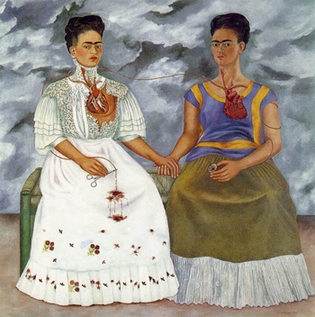
In 1939, Kahlo divorced Diego Rivera. That same year, on the largest canvas she had attempted up to that point, over 173 centimeters, she seated two Fridas side by side. Doris Maria-Reina Bravo, writing for the Smithsonian-affiliated art history platform Smarthistory, describes the two Fridas as "identical twins except for their clothing." And that difference in clothing was precisely the painful point for Kahlo at this time in her life.
One Frida wears a white European-style lace dress, the kind she wore before marrying Rivera. The other wears a Tehuana costume — the traditional dress of Zapotec women from the Isthmus of Tehuantepec — which is the style she adopted after marrying Rivera. Both figures' hearts are exposed. In Bravo's words, they are hearts left "vulnerable, exposed to the viewer" as evidence of emotional pain.
A single blood vessel connects the two Fridas. The European Frida holds a miniature portrait of a young Diego in her hand, and the vessel extends to that portrait, continuing to "feed" her feelings for him. The stronger Frida on the other side tries to cut off that vessel with a hemostat. One self still clinging to a lost love, and another self trying, literally, to sever the tie. Two voices within a single person, seated together on one bench, holding hands.
The background is a stormy sky. Bravo reads this work as an exploration of Kahlo's "culturally mixed heritage" — two identities, one from a European father and one from a Mexican mother, layered atop the personal rupture of divorce. Interestingly, this Smarthistory commentary makes no mention of Surrealism or André Breton. Like Kahlo herself, this reading treats the painting not as a dream, but as a depiction of her actual reality.
A single blood vessel connects the two selves, and one tries to cut it with a hemostat. The self that cannot let go of love, and the self trying to sever it.
A dead hummingbird around her neck, and behind her, a black cat and a monkey
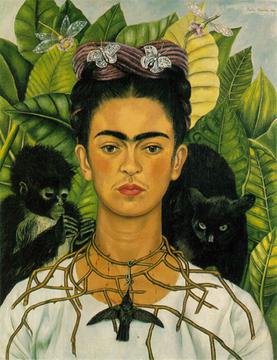
This 1940 self-portrait, oil on canvas, measures roughly 61 centimeters. According to the Harry Ransom Center, Kahlo gave this painting to photographer Nickolas Muray immediately after finishing it, and the Center acquired it in 1965 as part of the Muray Collection. The Center describes it plainly as often read as "a visual declaration of Kahlo's personal resilience and strength."
Kahlo faces us head-on. Around her neck is wound a necklace of thorns, and at its end hangs a dead, stiffened black hummingbird with its wings spread, like a pendant. Scholarly interpretations diverge. According to sources cited on Wikipedia, one reading (Fuentes and Kahlo) holds that the hummingbird is an amulet from Mexican folklore for luck in love, while another (Baddeley) reads it as a symbol of Huitzilopochtli, the Aztec god of war. The thorn necklace is likened to Christ's crown of thorns, an interpretation (Pankl and Blake) that transposes the pain of a failed love into the pain of a martyr.
Two animals sit on her shoulders: a black cat, said to represent bad luck and death, and a black spider monkey. This monkey was, in fact, an animal Rivera had given to Kahlo. One reading (Fuentes and Kahlo) accordingly sees the monkey as the one pulling the thorn necklace tight enough to draw blood — a stand-in, that is, for Rivera's shadow.
A butterfly and a dragonfly rest among her hair. Set against the dead hummingbird, these are read (Pankl and Blake) as symbols of resurrection. Death and rebirth, pain and recovery, sit side by side within a single frame. Perhaps this painting holds our attention so long precisely because it never tips fully toward either side.
A butterfly lands on a dead hummingbird. Within the same frame, an ending and a new beginning sit side by side.
One Art History Story a Week — on Instagram
See exhibition news and masterwork stories first, in reels and cards.
Instagram · Updated weekly
Curators behind this story
The facts and interpretations in this story are grounded in the public materials of the experts and institutions below. See each original for the full commentary.
- Wikipedia (citing Lindauer 2011, Kettenmann 2000, and others) · The Broken Column entry (Attribution)
- Doris Maria-Reina Bravo (Smarthistory, co-directed by Beth Harris and Steven Zucker) · Smarthistory (Attribution)
- Harry Ransom Center official commentary (no named curator credited) · Harry Ransom Center, University of Texas at Austin (Attribution)
- Wikipedia (citing Fuentes & Kahlo, Baddeley, Pankl & Blake) · Self-Portrait with Thorn Necklace and Hummingbird entry (Attribution)
Business Inquiry
Leave your partnership proposal and we'll review and reply.