The man who rationed light — Rembrandt van Rijn
Militiamen cropped from broad daylight, a thief's forearm, and a face that had passed through bankruptcy. Walking through three rooms Rembrandt left behind
3 chaptersAbout 8 min read
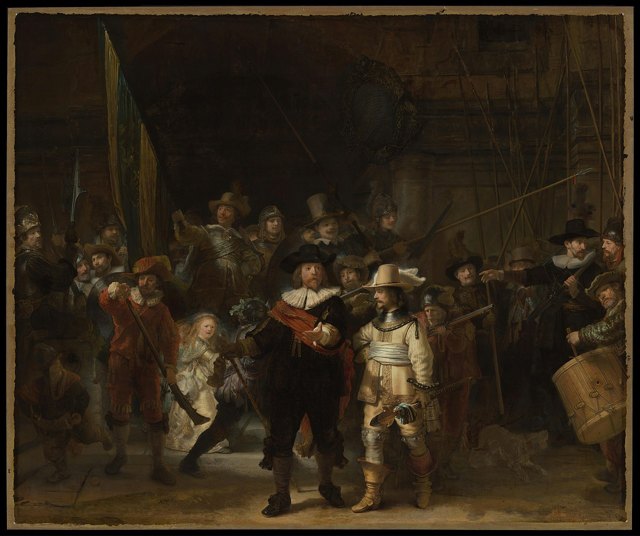
Light is not free. Rembrandt seems to have known this. Rather than scattering light evenly across a canvas, he doled it out sparingly, only where it was needed. Darkness was not waste, but a choice. The more he entrusted to darkness, the brighter the lit places became. In the Rijksmuseum in Amsterdam hangs a painting once trimmed at all four corners to fit a wall. In the Mauritshuis in The Hague is a scene, painted by a 26-year-old, of an executed thief's forearm being opened. At Kenwood House north of London, an old man who has passed through bankruptcy and loss holds a brush and palette, gazing straight at us. Three rooms. Three lights. Let us walk slowly between them.
Broad daylight, cropped
The title was wrong from the very beginning. This painting is not set at night. It only looked black because of a thick layer of old varnish; the moment when Captain Frans Banning Cocq's militia takes up arms and moves out was closer to broad daylight. The Rijksmuseum is still, even now, removing that old varnish. As the museum has stated: "We are removing old varnish layers from Rembrandt's masterpiece to preserve this work optimally for future generations." Inside a glass chamber, before the eyes of visitors, bit by bit, under a microscope.
But the painting we see today is not the whole of what Rembrandt painted. In 1715, when the painting was moved to Amsterdam's town hall, all four corners were trimmed to fit the wall. The museum's records even preserve the exact widths that were cut: 64.4 centimeters from the left, 23.3 centimeters from the top, 11.3 centimeters from the bottom, and 7 centimeters from the right. One painting was cut down for the sake of one wall.
The fact that the largest piece was cut from the left has long stayed with me. There, three figures had stood on a bridge — two militiamen and a child. The compositional weight had leaned a little further in that direction, and the procession had flowed out from further to the left than it does now. Museum director Taco Dibbits puts it plainly: "The composition Rembrandt painted was far more dynamic than what we see today."
In 2021, the Rijksmuseum reconstructed the missing sections and attached them around the edges of the original painting. The basis for this was a 17th-century copy commissioned by Captain Frans Banning Cocq himself — a small copy believed to have been painted by Gerrit Lundens sometime between 1642 and 1655. A sentence from Pieter Roelofs, head of paintings and sculpture, quietly sums up the whole project: "Every generation has tried to restore this painting with whatever tools it had at hand." This generation's tool was artificial intelligence. The research team trained a neural network on Rembrandt's technique and color, and the computer repainted the missing sections in Rembrandt's manner. Chief scientist Robert Erdmann says: "It is thanks to artificial intelligence that we can get this close to the original."
But what was brought back to life was a printed panel. The original remains cropped, just as it was. We now know what was cut away. Knowing this, we stand before the cropped painting. The empty space begins to become visible.
One painting was cut down for the sake of one wall. And three hundred years later, instead of recovering what was lost, we learned how to know what it had been.
The thief's forearm
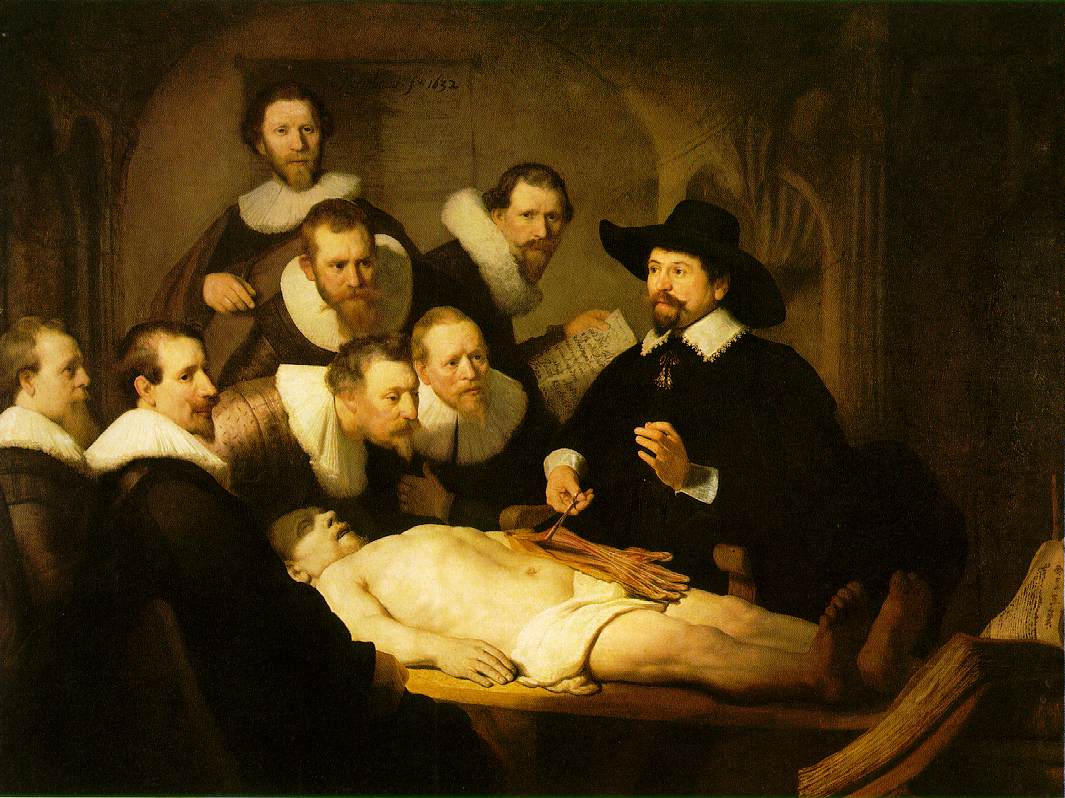
January 1632, Amsterdam. A man named Adriaen Adriaenszoon — known as Aris Kindt — was hanged for the theft of a coat. The Mauritshuis's records preserve even the exact date: he was hanged on January 31, and his body was handed over to the surgeons' guild for its annual public dissection. The pale body lying on the table in the painting is that thief.
Rembrandt was twenty-six at the time. It was the young painter's first major group portrait, and he quietly broke with the conventions of the genre. Until then, figures in such paintings stood in a row, staring straight ahead. Rembrandt did not do this. As the Mauritshuis explains: "Rembrandt's group portrait is far more dynamic than any other. He created movement by having the figures look in different directions." One looks at the corpse, another at a book, another at you. Within a still image, a flow of gazes emerges.
Nor is it a coincidence that Dr. Tulp opens the arm first. Normally, dissection began with the abdomen, which decays fastest. The Mauritshuis suggests this was Tulp's own choice. On the cover of Andreas Vesalius's classic anatomy text "De Humani Corporis Fabrica" (1543), there is a portrait of the author holding a dissected arm — and Tulp may have wanted to follow in the footsteps of that great predecessor. The lecture was also a ritual linking a lineage of knowledge.
The coldest fact lies in the hand. X-ray imaging has revealed that Rembrandt originally painted not a hand, but the stump of an amputated wrist. Aris Kindt, a habitual thief, had lost his hand in an earlier sentence. The place where the thieving hand had been cut off. Later — whether by Tulp's request or Rembrandt's own decision — a whole hand was painted over it. Beneath the surface lies the truth; on the surface, a completed hand.
Light gathers only on the pale body of the corpse and the faces gathered around it. Everything else is darkness. Even facing death, these men lean in to learn. Rembrandt already understood, at twenty-six, the moment a thief's forearm becomes knowledge.
The place where the thieving hand had been cut off. Rembrandt first painted that stump, then later painted a whole hand over it. The truth remained beneath the surface.
A face that had passed through bankruptcy
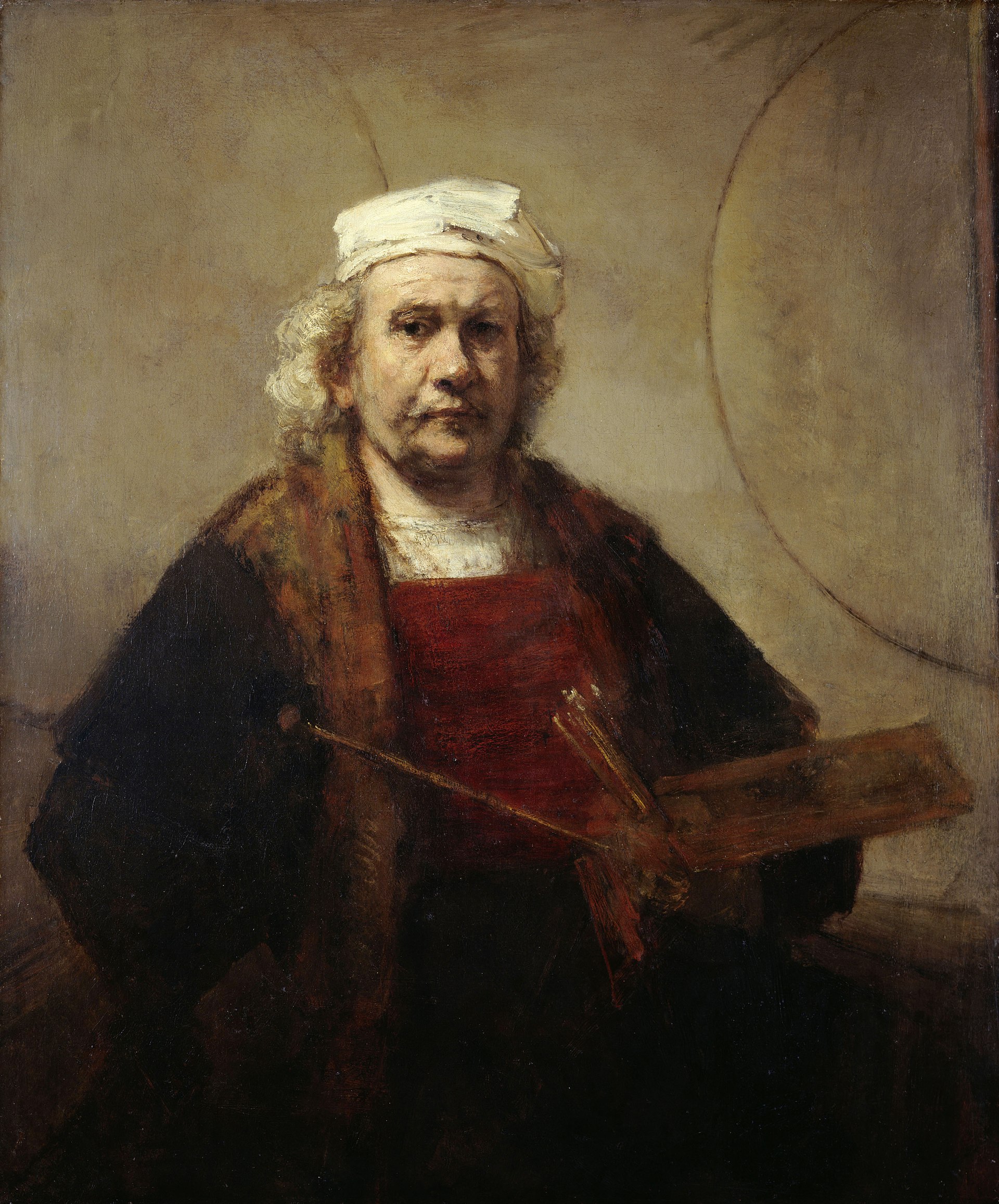
An old man looks straight ahead. He wears a white linen cap, holding in his left hand a palette, brushes, and a maulstick. His right hand disappears into a blurred smudge that could be a fold of cloth or his thigh — it is impossible to tell. He is in the act of painting right now. He is painting himself, as a working man.
Rembrandt was around fifty-nine when he painted this work. English Heritage records plainly the road he had traveled: bankruptcy (1656), the loss of the beloved house and collection he had built, and the death of his companion Hendrickje Stoffels (1663). Here is the face that emerged after passing through all of that. English Heritage calls this one of the largest and most dignified of all his self-portraits, known for its "technical brilliance and unflinching honesty." Unflinching honesty — meaning he did not flatter his own face.
Behind him hang two enigmatic circular shapes. No one has ever interpreted them with certainty. Some read them as a 17th-century Kabbalistic symbol of divine perfection; others see them as an ideal of painting in which natural talent, theory, and practice merge into one. The circles offer no answer. But before that unfinished curve, the face of the old man holding the brush comes into sharper focus.
The palette is rendered roughly, as if painted in haste. The hand is blurred. Rather than refining toward completion, Rembrandt left certain things unfinished — as the hands of someone who has lived long tend to be. As someone who already understands everything does not bother explaining it all. Only the face is clear. That is where the light gathers.
A man who enjoyed wealth and fame, lost it all, and still would not put down his brush. To the very end, he made himself his own model. Past the cropped militiamen of the first room, past the executed thief of the second, we finally arrive before the face of a single man. The light he had rationed his whole life, he finally spent on his own face.
He enjoyed wealth and fame, lost it all, and still would not put down his brush. The light he had rationed, he finally spent on his own face.
One Art History Story a Week — on Instagram
See exhibition news and masterwork stories first, in reels and cards.
Instagram · Updated weekly
Curators behind this story
The facts and interpretations in this story are grounded in the public materials of the experts and institutions below. See each original for the full commentary.
- Taco Dibbits, Director · Rijksmuseum (Attribution)
- Pieter Roelofs, Head of Paintings and Sculpture · Rijksmuseum (Attribution)
- Robert Erdmann, Senior Scientist · Rijksmuseum (Attribution)
- Mauritshuis official collection commentary · Mauritshuis, The Hague (Attribution)
- Smarthistory (Dr. Steven Zucker · Dr. Beth Harris) · Smarthistory (Attribution)
- English Heritage, Kenwood House official commentary · English Heritage (Kenwood House) (Attribution)
Business Inquiry
Leave your partnership proposal and we'll review and reply.