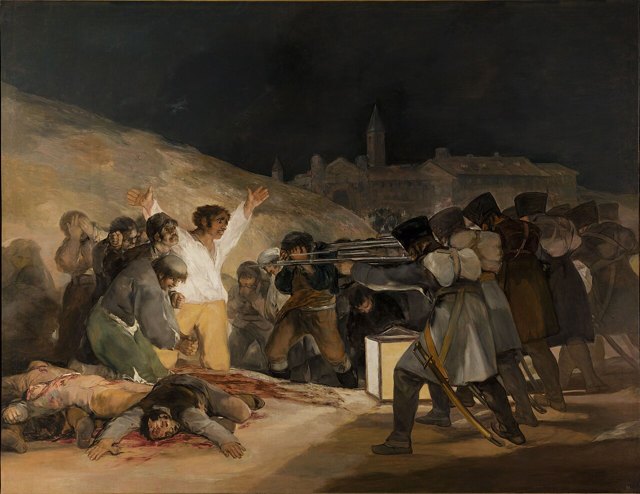
The Third of May 1808
The Third of May 1808 (El tres de mayo de 1808)
Collection Prado Museum · Madrid
A painting of French troops massacring Spanish civilians — what truth lies behind it?
Key Points
- A scene of confrontation between French troops and Spanish civilians
- A man in white extends his arms like a crucifixion
- The painting in which Goya first powerfully expressed the horror of war
- A work commemorating Spain's resistance against the French
Reading the Work
This painting depicts the massacre of Spanish civilians by French troops in Madrid on May 3, 1808. On the right, French soldiers take aim with their rifles; on the left, Spanish civilians face death side by side. Among them, a man in white stands out, his arms outstretched like a crucifixion.
Goya used a dark background to heighten the tension of the scene. The faces of the French soldiers are not shown, giving the impression that they are acting without any feeling. The Spanish civilians, in contrast, include some who have already fallen and others who face the guns directly. The yellow trousers of the man in white stand out against the dark background.
This painting was the first to powerfully express the horror of war and holds an important place in art history. Goya departed from traditional artistic conventions to convey emotion and reality with great force. This work later inspired many artists and became a foundation for modern art dealing with the subject of war.
One Art History Story a Week — on Instagram
See exhibition news and masterwork stories first, in reels and cards.
Instagram · Updated weekly
Further reading · Smarthistory · CC BY-NC-SA 4.0
Image: Public domain · Wikimedia Commons
Last updated 2026-07-17
Business Inquiry
Leave your partnership proposal and we'll review and reply.