Osberg House
Osborne House
Source: Wikidata · Last verified 2026-07-18
A museum located in East Cowes, United Kingdom.
About
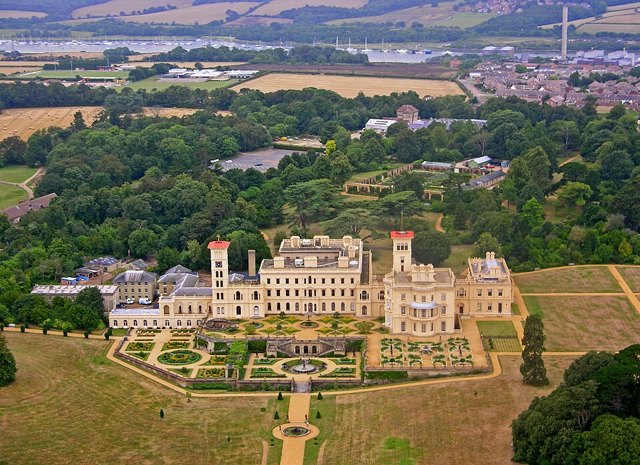
In 1845 Queen Victoria and Prince Albert, seeking a private retreat from the pressures of London and Windsor, purchased the Osborne estate at East Cowes on the Isle of Wight. Finding the existing Georgian house too small for their growing family, they turned to master builder Thomas Cubitt, who designed a new residence in close collaboration with Albert himself. Built in the Italianate style to suit a climate and view that reminded the Prince of the Bay of Naples, the house rose in stages: the Pavilion, with the couple's private rooms and nurseries, in 1846; the household wing in 1848; and the main wing, built after the old house was demolished, in 1851. Inside, the Durbar Room, completed in 1892, remains the house's most striking addition — designed by John Lockwood Kipling in a northern Indian style and finished with ornamental plasterwork by the Indian craftsman Bhai Ram Singh. The estate once covered more than 2,000 acres and today still spans 354 acres of terraced gardens, parkland, and a walled eighteenth-century garden. Tucked into the grounds stands the Swiss Cottage, where the royal children learned to garden and cook and kept a small museum of their own collected objects. Victoria died at Osborne House on 22 January 1901. Her son Edward VII, who felt no attachment to the place, gave it to the nation on his coronation day in 1902, and from 1903 to 1921 it served as the Royal Naval College, Osborne, training young officers. The ground floor opened to the public in 1904, and in 1954 Queen Elizabeth II allowed the sealed private apartments of Victoria and Albert to be shown as well — the house now stands as a museum in the care of English Heritage.
Osborne, East Cowes, Isle of Wight, England, PO32 6JZ, United Kingdom
Business Inquiry
Leave your partnership proposal and we'll review and reply.