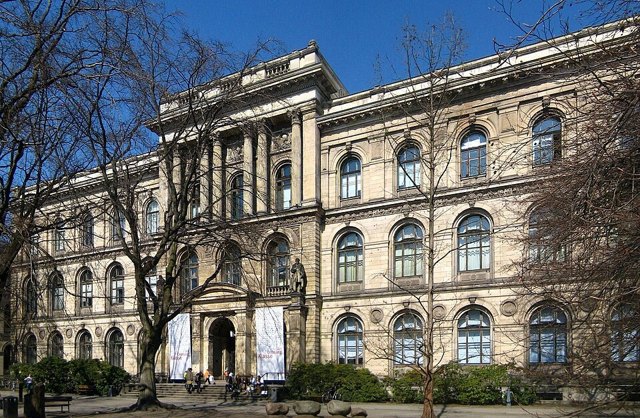
Museum of Natural Sciences - Leibniz Institute for Evolution and Biodiversity Science
Museum für Naturkunde - Leibniz Institute for Evolution and Biodiversity Science
Source: Wikidata · Last verified 2026-07-18
It is an art museum in Berlin, Germany.
About
Inside the building raised between 1875 and 1880 on the site of a former royal iron foundry on Berlin's Invalidenstraße, the first thing to fill your view is the towering skeleton of Giraffatitan — 13.27 meters tall and roughly 50 tonnes in life, now known as the largest mounted dinosaur skeleton in the world. The museum opened on 2 December 1889, was heavily damaged in the Second World War, and reopened on 16 September 1945 — the first Berlin museum to do so after the war. In another hall stands the Archaeopteryx known as the 'Berlin Specimen,' recovered from German limestone beds in 1871 and considered the most complete of the twelve Archaeopteryx fossils found to date. The glass-walled Wet Collection Wing holds over a million specimens preserved in ethanol across 276,000 jars, layering decades of collected life within a single room. Founded in 1810 as part of Berlin University, the museum today holds more than 30 million zoological, paleontological, and mineralogical specimens.
European Citizen Science Association, 43, Invalidenstraße, Charitéviertel, Mitte, Berlin, 10115, Germany
Business Inquiry
Leave your partnership proposal and we'll review and reply.