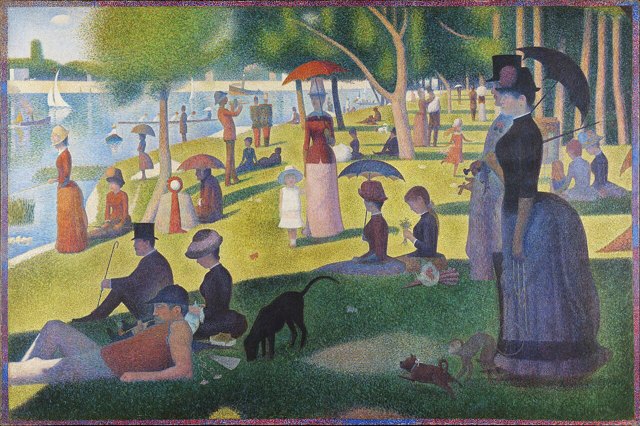
A Sunday Afternoon on the Island of La Grande Jatte
A Sunday on La Grande Jatte — 1884
Collection Art Institute of Chicago · ChicagoMuseum info & exhibitions →
The figures paused along the riverbank in Paris seemed to be hiding something in their eyes.
Key Points
- The daily life of Parisians unfolds in points — one of art history's greatest experiments
- An innovative technique that divides light and color to blend them "in the eye"
- The gaze of one woman in the painting is fixed steadily on the viewer
- The untold story of how colors faded over a century were digitally restored
Reading the Work
This painting depicts Parisians relaxing on the Island of La Grande Jatte on the Seine River. On the right, a woman holding a parasol and a man wearing a top hat stroll together; along the riverbank, a person fishes while a dog wearing a white ribbon collar runs by. In the center of the painting, a young girl in white looks directly at the viewer, posing a silent question.
Seurat used "pointillism," a technique that divides color into dots to be blended by the viewer's eye. The yellow of the grass was made with zinc yellow pigment, which turns brown when exposed to strong light. The border of the painting is rendered in inverted colors, hinting that the world around it is gradually changing. The fishing rod along the riverbank has also been interpreted as a metaphor for prostitution.
Seurat's painting represents the pinnacle of Divisionism and is the first work in art history to visually express modernity. He depicted the everyday life of ordinary people through a scientific approach, moving beyond the limits of Impressionism to chart a new direction for art. This work laid the foundation for later Modernism and remains one of the most beloved paintings in the museum.
One Art History Story a Week — on Instagram
See exhibition news and masterwork stories first, in reels and cards.
Instagram · Updated weekly
Further reading · Smarthistory · CC BY-NC-SA 4.0
Image: Public domain · Wikimedia Commons
Last updated 2026-07-17
Business Inquiry
Leave your partnership proposal and we'll review and reply.